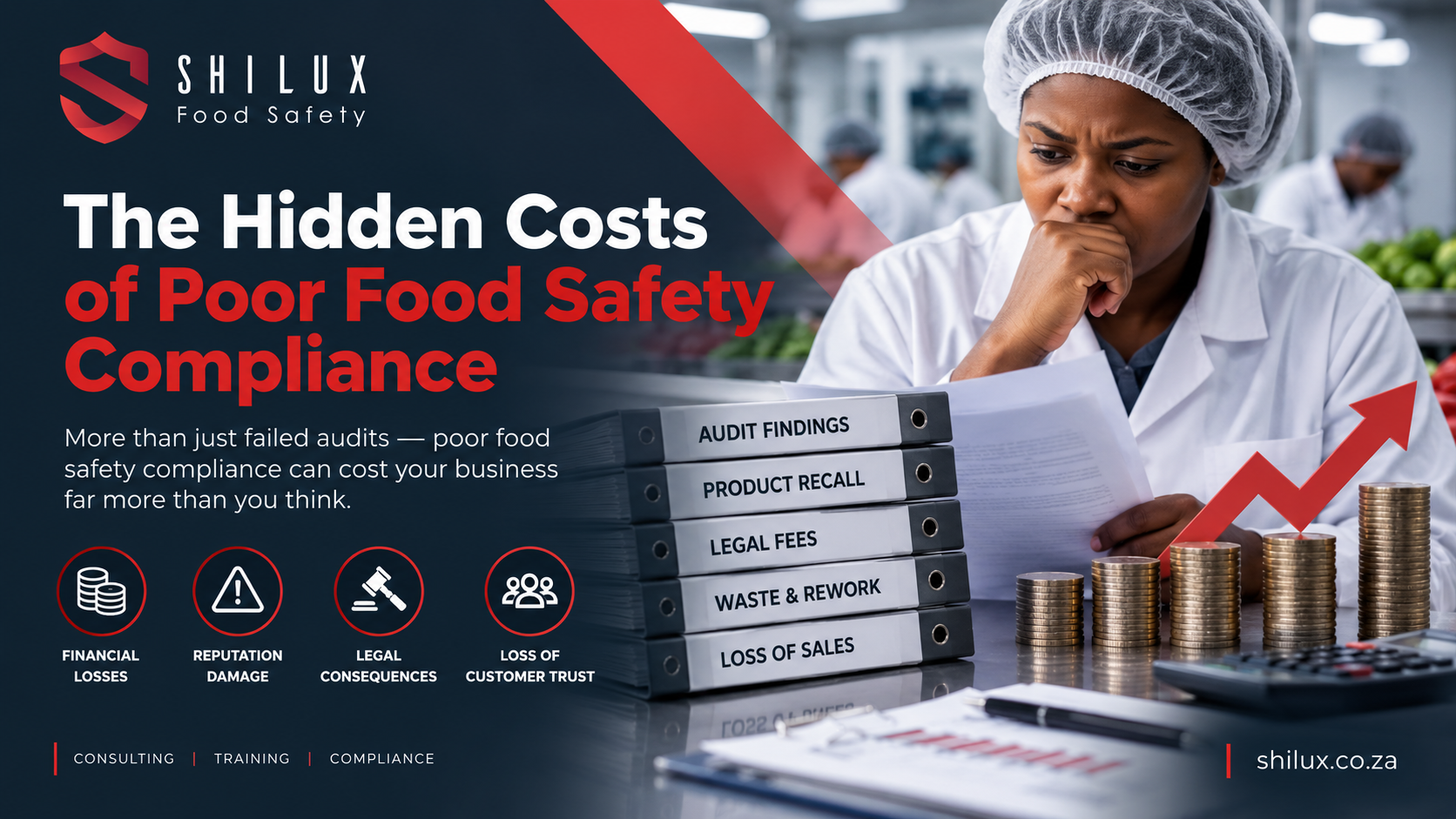
Poor food safety compliance costs a business far more than the price of fixing an audit finding. The real impact can spread across production losses, wasted stock, customer complaints, staff retraining, rejected deliveries, lost contracts, management time and damage to brand confidence. For South African food businesses, the strongest approach is to treat food safety as an operational control system rather than a paperwork exercise.
Key takeaways
- Poor compliance creates direct costs such as waste, rework, downtime, product holds and corrective actions.
- The larger costs are often indirect: lost customers, retailer confidence, delayed tenders, damaged reputation and management time.
- South African legal obligations should be separated from certification and customer requirements, but all three can affect commercial viability.
- Strong HACCP, prerequisite programmes, verification, training and corrective action processes reduce both food safety risk and business disruption.
- Digital systems such as QMSURE can improve visibility, accountability and audit readiness when implemented properly.
Why food safety non-compliance becomes expensive so quickly
A failed inspection or audit finding is often only the visible symptom. Behind it may be poor controls, missing verification, weak supervision, incomplete cleaning records, ineffective traceability or inadequate training. Once a weakness reaches production, dispatch or the customer, the cost multiplies.
A business may need to stop a line, isolate product, conduct an investigation, repeat cleaning, rework stock, retrain employees, update procedures, contact customers and verify corrective actions before normal operations resume. None of these activities directly create saleable product, yet they consume labour, management attention and production capacity.
This is why food safety should be viewed as part of operational performance. A well-designed food safety management system helps prevent avoidable disruption while providing evidence that controls are working.
1. Waste, rework and product loss
One of the most immediate financial effects of poor compliance is product loss. If contamination is suspected, temperature controls are not verified, allergen controls fail or traceability records are incomplete, a business may be unable to demonstrate that affected product is safe or correctly controlled.
The result can be product holds, disposal, rework, additional testing or delayed release. Even where the product itself is not unsafe, weak records can make it difficult to prove compliance. Good documentation therefore protects both food safety and the commercial value of the product.
Effective prerequisite programmes for cleaning, pest management, personal hygiene, maintenance, storage and cross-contamination control help prevent recurring losses before they reach this stage.
2. Production downtime and lost capacity
A serious food safety deviation can stop production. Equipment may require deep cleaning, maintenance or verification before restart. Supervisors may need to investigate the cause, while quality personnel review records and determine the status of affected batches.
The hidden cost is not only the hours when the line is stopped. Production plans may need to change, customer orders may be delayed and overtime may be required to recover lost output. Repeated incidents also reduce confidence in scheduling and make the business more reactive.
A strong verification programme helps identify weaknesses earlier. Internal inspections, trend reviews and internal audits should be used to detect deterioration before it causes a major interruption.
3. Failed audits and corrective-action pressure
Audit findings carry a cost even when certification is not immediately threatened. Teams must investigate root causes, prepare corrective actions, collect evidence and demonstrate that the issue has been sustainably addressed.
Weak corrective action creates a second risk: recurrence. Closing a finding by changing a document without addressing why the failure occurred may satisfy an administrative deadline but does not protect the operation. A stronger approach uses structured root cause analysis and corrective and preventive action to address the system weakness behind the finding.
For certified businesses, repeated or serious non-conformities can also affect certification status and customer confidence. Certification requirements such as FSSC 22000 or ISO 22000 should not be confused with legislation, but they can still be commercially critical where customers require certification as a condition of supply.
4. Customer complaints and rejected product
Food safety and quality failures often become most expensive when they are first detected by the customer. Complaints may require investigation, replacement stock, credit notes, collection of product and additional testing. More importantly, they may change how the customer evaluates the supplier.
A single complaint does not necessarily mean a system is failing. However, repeated complaints, slow investigations or weak corrective actions suggest that the business is not learning from its data. Complaint trends should therefore feed back into management review, training, supplier controls and process improvement.
5. Recalls and withdrawals
A product recall or withdrawal can create costs across logistics, customer communication, investigation, product replacement, disposal and recovery of stock. The disruption can be especially severe when traceability is slow or incomplete.
Businesses should be able to identify affected raw materials, production batches and customers quickly enough to support effective action. Regular traceability exercises and mock recalls help test whether the system works under pressure rather than assuming it will work when needed.
Good traceability also limits the scope of an incident. If records clearly identify what is affected, the business may avoid unnecessarily holding or withdrawing unaffected product.
6. Legal and regulatory exposure in South Africa
South African food businesses must comply with applicable food legislation and local authority requirements. For food premises, Regulation R.638 under the Foodstuffs, Cosmetics and Disinfectants Act is particularly relevant to general hygiene requirements and the Certificate of Acceptability process for applicable premises.
Legal compliance must be considered separately from voluntary certification schemes. A company can hold a certification and still fail a legal requirement, or meet basic legal requirements without meeting a retailer or certification standard. Businesses should identify each category clearly: legislation, customer requirements and certification or industry standards.
Where a business is uncertain about its legal obligations, it should confirm requirements applicable to its products, processes and local authority jurisdiction rather than relying on generic checklists.
7. Lost customers, contracts and tenders
Many food manufacturers and suppliers depend on customer approval programmes. Buyers may require evidence of HACCP implementation, a recognised certification, approved supplier status, traceability capability, testing programmes or documented hygiene controls.
Poor compliance can therefore affect revenue even without a regulator imposing a penalty. A failed supplier audit, repeated complaint trend or unresolved corrective action can delay onboarding, block a tender or cause an existing customer to seek an alternative supplier.
This is one of the most significant hidden costs because the lost opportunity may never appear as a food safety expense in the accounting system.
8. Damage to reputation and customer trust
Trust is difficult to measure but expensive to rebuild. Customers expect food businesses to control foreseeable hazards and respond professionally when something goes wrong. A slow, defensive or poorly documented response can damage confidence even when the initial incident is contained.
Strong food safety culture matters here. Employees should understand that records, hygiene practices, escalation and corrective actions exist to protect consumers and the business, not merely to satisfy an auditor. Explore our guide to food safety culture for practical ways to strengthen behaviour and accountability.
9. Management time and administrative overload
When a food safety system is poorly implemented, senior employees spend more time chasing records, correcting forms, preparing for audits and responding to problems. The organisation becomes dependent on a small number of people who understand where documents are stored and how to fix recurring gaps.
This creates operational risk. Food safety should be embedded into daily responsibilities with clear ownership, escalation rules and verification. Managers should spend their time reviewing performance and improving controls rather than repeatedly reconstructing missing evidence.
10. Training costs caused by repeated failure
Training is necessary, but repeated retraining is often a sign that the root cause has not been addressed. If staff continue making the same mistake, the problem may be unclear procedures, poor supervision, unsuitable equipment, unrealistic workloads or weak accountability rather than lack of knowledge alone.
Training should therefore be linked to competence checks and observed behaviour. Shilux offers practical food safety training that can be aligned with the responsibilities employees perform in the workplace.
How to reduce the hidden cost of non-compliance
The goal is not to create more paperwork. It is to build controls that provide useful evidence and make failures visible early.
- Define ownership: Every key control should have a responsible person and a clear verification step.
- Use risk-based priorities: Focus resources on hazards and failures that can cause the greatest food safety or business impact.
- Verify, do not assume: Review records, observe practices, trend results and test traceability.
- Investigate recurring issues: Use root cause analysis instead of repeatedly correcting symptoms.
- Strengthen training: Measure competence and workplace behaviour, not attendance alone.
- Digitise where it adds control: Digital records can improve visibility, escalation and trend analysis when workflows are well designed.
Where digital food safety management can help
Paper systems can work, but they become difficult to control when the volume of records, sites, users and corrective actions increases. A digital platform such as QMSURE can help centralise records, assign responsibilities, flag missing checks and make information easier to retrieve during audits.
Digitalisation is not a substitute for a good food safety system. The process still needs correct limits, responsibilities, verification and management oversight. The advantage is that good controls become easier to see and manage in real time.
Food safety compliance should protect the business, not just pass the audit
The true cost of poor food safety compliance is rarely found in one invoice. It appears across waste, downtime, complaints, lost sales, damaged trust, corrective actions and management time. Businesses that treat food safety as a core operating system are better placed to prevent these losses and respond quickly when problems occur.
If your organisation is spending too much time preparing for audits, fixing repeated findings or trying to reconstruct missing records, the underlying system may need attention. Contact Shilux Food Safety for support with compliance assessments, HACCP implementation, certification readiness, training and digital food safety management.