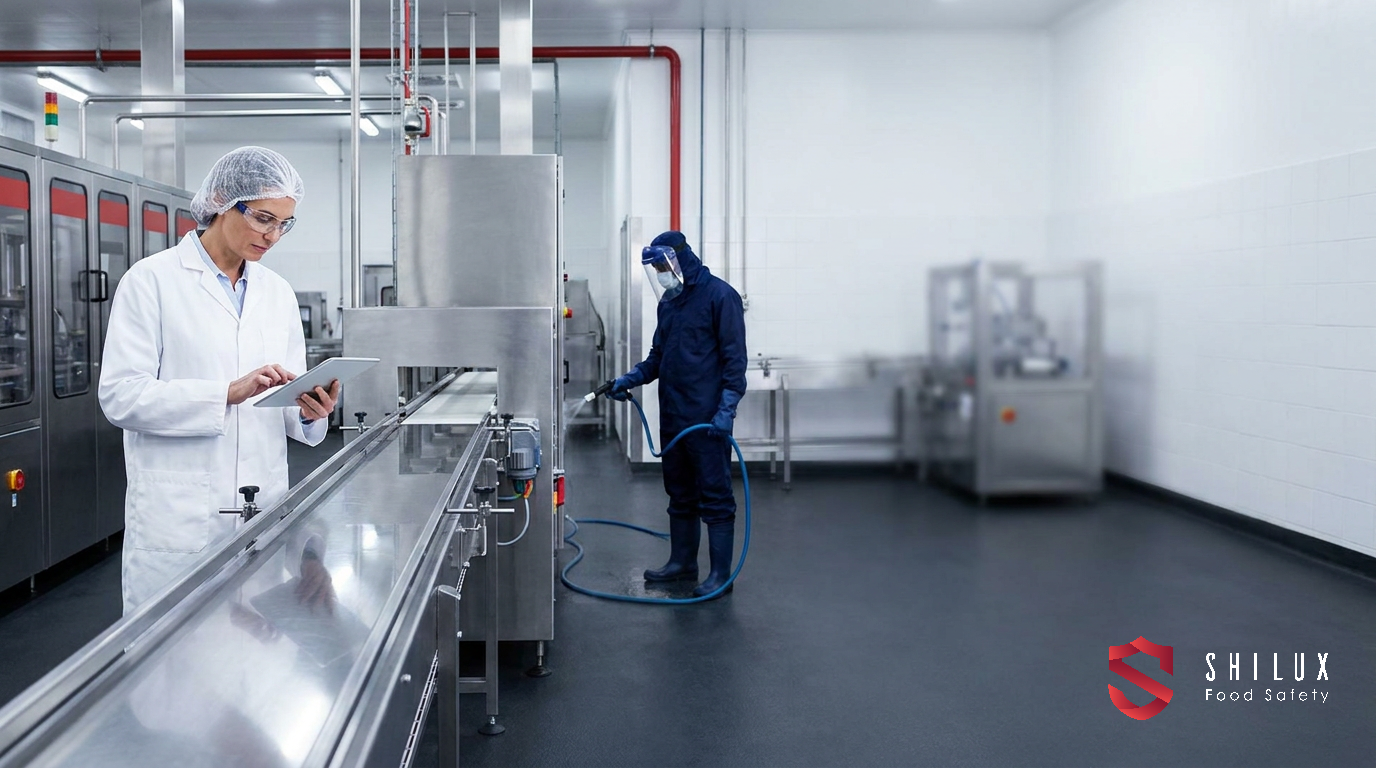
The Foundation of Food Safety
An effective cleaning and sanitation programme is a structured system designed to remove food soil, dirt, and microorganisms from the food processing environment to prevent contamination. In South Africa, a robust programme is not merely best practice; it is a legal mandate under the Foodstuffs, Cosmetics and Disinfectants Act 54 of 1972 and its associated Regulations Governing General Hygiene Requirements for Food Premises (R.638). A successful programme must be documented, validated, and consistently verified to ensure the safety of the final product and the protection of the consumer.
Sanitation is the bedrock upon which all other safety systems are built. Without a clean environment, even the most advanced HACCP plan will fail because the biological load of the facility remains uncontrollably high. The "why" behind sanitation is simple: food soils (fats, proteins, and carbohydrates) act as a protective biofilm for pathogens. If these soils are not chemically and mechanically removed, sanitisers cannot reach the underlying bacteria, leading to persistent contamination issues.
- Legal Compliance: Ensure your facility meets the R.638 requirements for a Certificate of Acceptability.
- Documented SSOPs: Every piece of equipment and floor area must have a specific, step-by-step cleaning procedure.
- Validation vs. Verification: Understand that proving a method works (validation) is distinct from checking if it was done (verification).
- Chemical Management: Use only NRCS-registered disinfectants and food-grade detergents with appropriate Material Safety Data Sheets (MSDS).
- Training: Move beyond compliance to build a food safety culture where staff understand the 'why' behind sanitation.
Legal and Regulatory Framework in South Africa
In the South African manufacturing landscape, the R.638 regulations serve as the baseline for all food premises. Regulation 10 specifically addresses the duties of the person in charge regarding the cleanliness of the premises and equipment. If your facility fails to maintain adequate sanitation, your Certificate of Acceptability can be revoked by the local Environmental Health Practitioner (EHP). This document is a non-negotiable requirement for any business handling food, and lack of compliance often results in immediate site closure during a food premises inspection.
For manufacturers moving toward FSSC 22000 certification or BRCGS, cleaning is classified as a critical Prerequisite Programme (PRP). These international standards, benchmarked by the Global Food Safety Initiative (GFSI), require significantly more detail than the local law, specifically regarding environmental monitoring and the prevention of cross-contact with allergens. While R.638 focuses on general cleanliness, standards like BRCGS demand evidence of validation—scientific proof that your chosen cleaning method actually eliminates the specific hazards present in your unique production environment.
Step 1: Developing Sanitation Standard Operating Procedures (SSOPs)
A generic "wash the belt" instruction is the primary reason for common food safety audit findings. An effective SSOP must be granular. It should detail the equipment to be cleaned, the chemicals to be used (including dilution rates), the contact time required, and the tools allowed (e.g., colour-coded brushes to prevent cross-contamination). In a South African context, SSOPs must also account for water quality and availability, ensuring that in times of water restrictions, alternative validated methods are ready.
The Seven Steps of Dry and Wet Cleaning
While every facility differs, the industry-standard seven-step process is a reliable framework for wet cleaning in high-risk environments, such as those found in the meat and poultry or dairy sectors:
- Dry Pick-up: Remove gross debris and food scraps. This prevents clogging drains and reduces the organic load that neutralises chemicals.
- First Rinse: Use warm water (usually 45–55°C) to remove remaining visible soil. Avoid high-pressure hoses which can create aerosols that spread bacteria to the ceiling.
- Apply Detergent: Use foam or manual scrubbing to break down proteins and fats. Detergent selection is key; for example, alkaline cleaners for fats and acidic cleaners for mineral scale.
- Post-Rinse: Remove all detergent and loosened soils. Residue left behind can interfere with the sanitiser.
- Inspect: A visual check to ensure no residue remains. Use a torch to check "dead spots" like the underside of conveyor belts.
- Sanitise: Apply a chemical disinfectant to kill remaining microorganisms. Crucially, the surface must be clean before this step, as sanitisers are less effective in the presence of organic matter.
- Dry/Final Prep: Ensure the equipment is dry before production restarts. Stagnant water is a breeding ground for Pseudomonas and Listeria.
Common Failure Modes in SSOP Execution
Even well-written procedures fail due to operational realities. Common issues include:
- Incorrect Contact Time: Sanitisers often require 5-10 minutes of contact time to achieve the required log reduction of bacteria. Rushing this step renders the chemical application useless.
- Shadow Areas: Areas behind motor housings or inside hollow rollers are often missed. These become "harbourage sites" where bacteria multiply.
- Biofilm Build-up: Over time, bacteria create a protective slime layer. Standard cleaning may fail to remove this, requiring periodic "deep cleans" with specialised oxidative chemicals.
Step 2: Chemical Selection and Control
South African manufacturers must ensure that all disinfectants used are registered with the National Regulator for Compulsory Specifications (NRCS) under VC 8054. Using industrial-grade chemicals that are not food-approved is a major non-conformity. Furthermore, the storage of these chemicals must be secure, ventilated, and separated from production areas to prevent economically motivated adulteration or accidental chemical contamination.
Chemical titration is a vital part of the process. Sanitation staff should be trained to test the concentration of the prepared solution using test strips or titration kits. This ensures the chemical is within the manufacturer’s recommended range—usually measured in Parts Per Million (PPM). If the concentration is too low, the bacteria survive; if it is too high, you risk chemical taints in the food and damage to your stainless-steel equipment.
"The concentration of the chemical is as important as the chemical itself. Over-dilution leads to microbial survival; under-dilution leads to chemical residues and equipment corrosion."
Step 3: Verification and Validation
Auditors from bodies like BRCGS will scrutinise the difference between verification and validation. Verification is the daily check—did the cleaning happen? Validation is the scientific proof—does this cleaning method actually remove the hazards we are concerned about (e.g., Salmonella, Listeria, or allergens)?
A common mistake in internal audits is focusing only on the "check-box" of verification while ignoring validation. If you change a detergent or a piece of equipment, you must re-validate the cleaning process. This typically involves intensive swabbing over several days to prove that the new method consistently achieves the required hygiene standard.
| Activity | Method | Frequency | Responsibility |
|---|---|---|---|
| Verification | Visual inspection, ATP swabbing, UV torches | Daily / Post-Cleaning | QA Technician / Supervisor |
| Validation | Microbiological lab testing, allergen-specific swabs | Annually or after change | Food Safety Team Leader |
| Monitoring | Chemical titration (concentration checks) | Every Batch | Sanitation Team |
| Auditing | Direct observation of cleaning staff against SSOPs | Monthly | Internal Auditor |
Step 4: Managing Cleaning Tools and Cross-Contamination
Cleaning tools themselves can become vectors for contamination. A robust prerequisite programme must include a colour-coding system. For example, red brushes for floor drains, blue for food-contact surfaces, and yellow for outer casings. These tools must be cleaned and sanitised after use and stored on shadow boards to prevent them from sitting in stagnant water. Tools should be inspected weekly for damage; frayed bristles are a significant foreign body risk.
Environmental Monitoring Programmes (EMP)
In high-care or high-risk facilities (like ready-to-eat meat or dairy plants), cleaning effectiveness is measured through an EMP. This involves swabbing non-food contact surfaces like drains, cooling units, and foot baths for pathogens like Listeria monocytogenes. If an EMP shows recurring positives, it indicates a "niche" where bacteria are surviving the cleaning process, requiring a root cause analysis to rectify. A common failure in South African plants is cleaning the floor but then using a high-pressure hose that splashes contaminated water from the floor back onto the clean equipment (re-contamination).
Allergen Cleaning and Validation
For facilities handling multiple allergens (e.g., milk, soya, wheat), the sanitation programme is a critical control measure for preventing cross-contact. Cleaning between an allergen-containing run and an allergen-free run must be specifically validated using ELISA (Enzyme-Linked Immunosorbent Assay) testing. A visual check is never sufficient for allergen claims; you must prove the absence of the protein at the molecular level. Failure to do so can lead to a product recall, which carries immense financial and reputational cost.
Step 5: Documentation and Record Keeping
In the eyes of an auditor, if it isn't written down, it didn't happen. Cleaning records must be legible, contemporaneous, and signed off by a supervisor. Many South African SMEs struggle with paper-based systems where records are lost or filled in retrospectively. Transitioning to a digital food traceability system or electronic QMS can significantly reduce the risk of documentation errors. Digital systems can also timestamp entries, preventing the "Friday afternoon fill-in" where a week's worth of logs are completed in ten minutes.
Checklist for an Audit-Ready Cleaning File
- Master Cleaning Schedule (identifying what, when, and who).
- Detailed SSOPs for every piece of equipment, including dismantling instructions.
- Chemical Data Sheets (MSDS) and Technical Data Sheets (TDS).
- NRCS Registration certificates for all disinfectants (valid and current).
- Daily cleaning logs and post-cleaning inspection reports (verified by a second person).
- ATP or microbial swab results, including trend analysis.
- Training records for all sanitation staff, including Basic Food Safety Course certificates and specific chemical handling training.
- Corrective Action reports (CAPA) for when cleaning failed a swab test or visual check.
The Role of Leadership and Culture
Cleaning is often viewed as a low-skill, high-turnover task. However, the sanitation team is the first line of defence against a food recall. Management must invest in leadership in food safety to ensure that sanitation staff are empowered to stop production if a machine is not adequately cleaned. This requires a shift in food safety culture—viewing the cleaning crew not as janitors, but as hygiene technicians critical to the business's survival.
Regular internal audits are essential to catch lapses before they become systemic failures. By performing a hygiene audit, manufacturers can identify areas where the cleaning programme is lagging, whether due to inadequate equipment design (sanitary design) or lack of staff training. For instance, if a machine has "dead legs" or crevices that cannot be reached by chemicals, it needs a facility layout or equipment modification to ensure it is cleanable.
Continuous Improvement and CAPA
When a cleaning failure occurs—such as a failed ATP swab or a positive Listeria result in a drain—the response must go beyond simply re-cleaning. A robust Corrective and Preventive Action (CAPA) process is required. Using tools like the 5-Whys or a Fishbone Diagram can help determine why the cleaning failed. Was it a new staff member? Was the chemical supplier's dosing pump broken? Was the water temperature too low? Only by addressing these root causes can you prevent the failure from recurring.
Building a cleaning and sanitation programme requires a blend of regulatory knowledge, chemical science, and disciplined operational execution. By grounding your programme in the requirements of R.638 and the rigorous expectations of GFSI standards like FSSC 22000, you protect your business from the catastrophic costs of contamination and ensure a sustainable path to market access. Shilux provides expert food safety consulting to help you design and validate these programmes, alongside our QMSURE software which digitises your cleaning logs for real-time compliance oversight. Contact our team in Johannesburg, Cape Town, or Durban to move your facility toward a world-class sanitation standard.