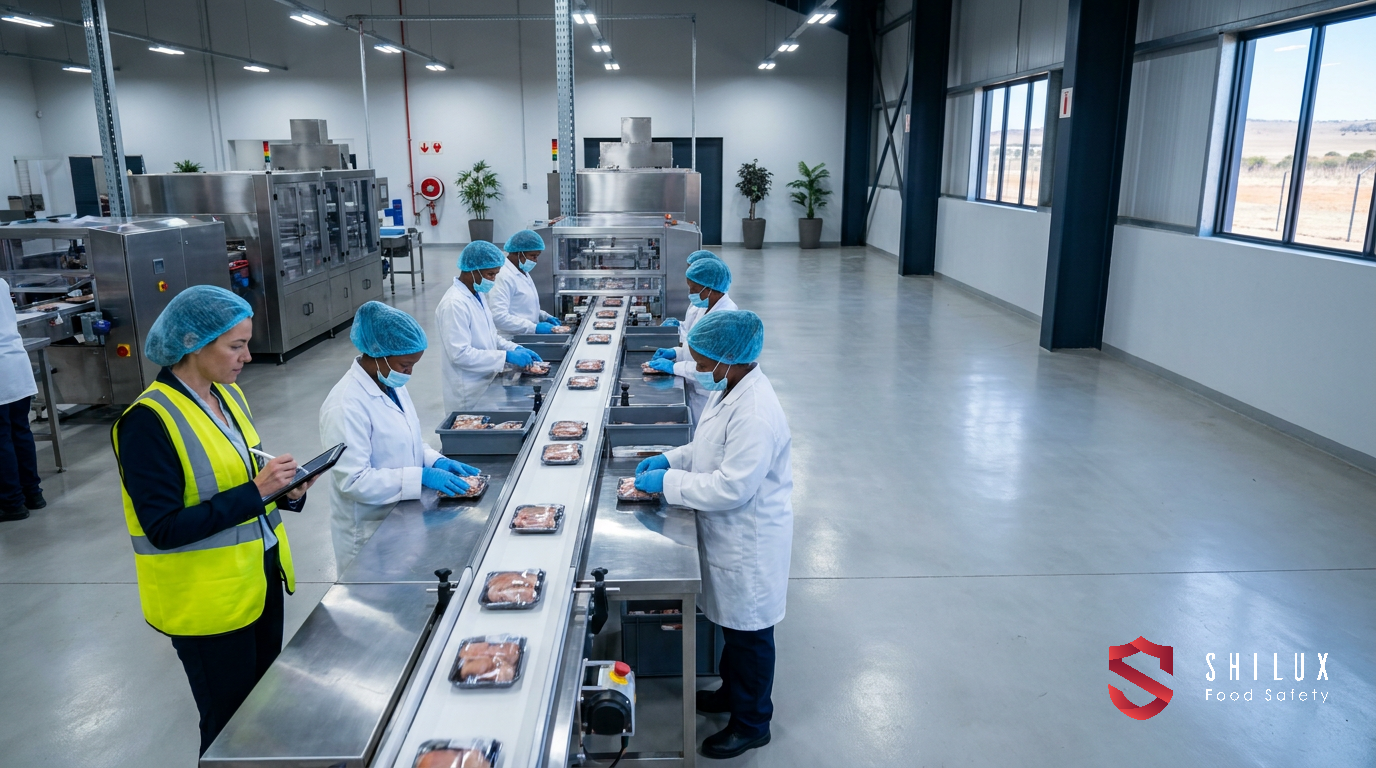
Preparing production staff for an unannounced food safety audit requires transitioning from periodic "cleaning for the auditor" to a permanent state of audit-readiness driven by a robust food safety culture. Success depends on empowering employees to execute standard operating procedures (SOPs) correctly every time, ensuring they can confidently explain their roles and the Critical Control Points (CCPs) they manage without supervision.
Key Takeaways
- Shift from "compliance for auditors" to "compliance for consumers" to foster a resilient food safety culture.
- Empower staff with the "Why" behind R.638 hygiene requirements and GFSI standards.
- Use internal gap audits to simulate the pressure of unannounced external visits.
- Ensure documentation is completed in real-time, never retrospectively.
- Provide staff with a clear communication protocol for interacting with auditors.
- Understand the critical difference between legal minimums and customer-driven certification.
The Shift to Unannounced Audit Reality
In the South African food manufacturing landscape, unannounced audits are no longer an optional challenge. Under schemes like FSSC 22000 and BRCGS, at least one surveillance audit in every three-year cycle must be unannounced. Unlike a planned visit, where management has time to verify every floor drain and record book, an unannounced audit captures the facility in its raw, daily operational state. This makes food safety culture the most critical factor in your success. When the auditor arrives at the gate, there is no time to fix broken tiles or hide unlabelled rework bins; the system must already be functioning at peak performance.
1. Legal vs. Certification Requirements: Knowing the Baseline
Before preparing staff for high-level GFSI audits, you must ensure the baseline legal requirements are met. In South Africa, the Foodstuffs, Cosmetics and Disinfectants Act 54 of 1972 and its associated regulation, R.638, dictate the minimum hygiene requirements for food premises. An Environmental Health Practitioner (EHP) can perform an unannounced inspection at any time to verify your Certificate of Acceptability (CoA).
While FSSC 22000 or ISO 22000 are voluntary certifications requested by retailers, the R.638 requirements are non-negotiable law. Staff must understand that while an auditor might raise a non-conformity against a certification clause, a failure to meet R.638 could result in legal action or the withdrawal of your CoA. Distinguishing between these helps staff understand the severity of different compliance layers. For instance, failing a metal detector test is a certification failure, but having no hot water at a hand-wash station is a violation of R.638 regulations that can shut down your facility.
Practical Operational Detail: The EHP Visit
Unlike a GFSI auditor who focuses on the management system, a South African Environmental Health Practitioner focus is on public health. They will look specifically for structural compliance: are floors non-absorbent? Are the ceilings dust-proof? Is there a valid Certificate of Acceptability displayed? Staff should be trained to recognize the difference between these regulatory inspections and customer audits to avoid confusion during the entry meeting.
2. Empowering Staff Through Daily Habits
The greatest risk during an unannounced audit is staff panic. When employees see an unfamiliar person with a clipboard, their first instinct may be to deviate from their routine or "hide" mistakes. Preparation involves removing this fear through consistent basic food safety training.
Mastering the Interview
Auditors today spend more time on the floor interviewing staff than in the boardroom reviewing files. Your production team should be able to answer three core questions regarding their specific station:
- What are you doing? (The SOP)
- Why are you doing it? (The Food Safety Risk)
- What do you do if something goes wrong? (The Corrective Action)
If a staff member at a metal detector cannot explain what happens to a rejected product, the facility will likely face a major non-conformity, regardless of how clean the floors are. A common failure mode is staff saying "I tell my supervisor" without knowing the actual HACCP critical limits or the procedure for isolating potentially contaminated stock.
3. Operational Detail: The "Audit-Ready" Checklist
Use the following table to assess if your production floor is ready for an auditor to walk in right now. These are the common "red flags" that unannounced auditors look for immediately upon entry.
| Focus Area | Critical Requirement | Staff Habit to Monitor | Why it Matters |
|---|---|---|---|
| Personal Hygiene | Compliance with R.638 Section 10 | Are masks worn correctly? Is jewellery removed? Are hand-washing protocols followed? | Prevents physical and microbial contamination from the handler to the food. |
| Chemical Control | Approved chemicals only; stored away from food. | Are cleaning chemicals labelled and stored in designated cabinets? | Incorrect storage leads to chemical tainting and accidental poisoning risks. |
| Traceability | Real-time batch identification. | Is every crate, bag, or bin on the floor clearly labelled with a batch code? | Crucial for executing a food recall procedure if a batch is found to be unsafe. |
| CCP Monitoring | Accurate, timely temperature/pressure checks. | Are records signed at the time of check, or are they being filled in at the end of the shift? | Retrospective logging hides fluctuations that could allow pathogen growth. |
| Tool Integrity | No "quick-fixes" (e.g., masking tape, wire). | Are maintenance staff using food-grade materials for temporary repairs? | Prevents foreign body contamination from non-standard materials. |
4. Implementing Internal "Surprise" Audits
The most effective way to prepare for an unannounced external audit is to conduct unannounced internal audits. The Quality Manager should pick a random Tuesday at 02:00 AM (if you run night shifts) to walk the floor. This identifies whether staff maintain standards when "nobody is watching." These sessions should not be punitive; rather, they should be used as coaching opportunities.
During these sessions, focus heavily on Prerequisite Programmes (PRPs). Common failures include open doors allowing pest entry, staff eating in non-designated areas, or the use of wooden pallets in high-care zones. If you find a gap, use a 5-whys analysis to understand if the failure was due to a lack of resources or a breakdown in training. Regular feedback sessions after these internal audits help demystify the process. When an actual external auditor arrives, the staff will view it as just another check.
5. Documentation Habits: The "Golden Rule"
In a food safety audit, if it isn't written down, it didn't happen. In an unannounced audit, auditors check for "contemporaneous record keeping." This means the time on the staff's log sheet should match the time on the auditor's watch. If the auditor arrives at 10:00 AM and the 09:00 AM check isn't signed, it’s a finding.
Encourage staff to report issues immediately. A record that shows a deviation followed by a CAPA process (Corrective and Preventive Action) is far better than a record that looks "perfect" but is clearly faked. An auditor values honesty and systemic control over perfection. For example, if a fridge temperature rises, a recorded correction (moving stock to a freezer and calling maintenance) proves the HACCP plan is working. Faking a "safe" temperature is a breach of integrity that can lead to immediate audit failure.
Managing Corrective Actions
Supervisors must be competent in root cause analysis. When a non-conformity is found during an internal check, don't just fix the surface issue. If a staff member isn't wearing a hairnet, the root cause might be a lack of supply at the entrance rather than simple negligence. Addressing the source prevents the finding from reappearing during the external audit. Refer to our guide on corrective action vs preventive action for more detail on long-term fixes.
6. Visitor and Contractor Management
Unannounced audits test your front-desk and security staff as much as your production team. Does your security guard know the protocol for an auditor? They should be treated as a visitor: they must sign the health questionnaire, be inducted on site safety, and be escorted at all times. However, management must not use these protocols to "stall" for time. An auditor will note if it takes 45 minutes to get past the gate while staff are seen frantically cleaning through the windows.
Maintenance contractors are another high-risk group. During an unannounced audit, an auditor may find a contractor working on a line without a proper "permit to work" or leaving tools on a food-contact surface. Ensure that food safety for maintenance staff is a mandatory part of your contractor induction process.
7. Managing Vulnerabilities: Food Fraud and Defence
In the context of unannounced visits, auditors often look for gaps in site security. Are external doors left propped open for ventilation? Are chemical stores left unlocked? These are immediate red flags for a food defence threat assessment. Staff must understand that "unauthorized personnel" includes anyone not wearing the correct site uniform or visitor badge. If a staff member challenges an unescorted auditor, it is actually a positive sign of a strong food safety culture.
Furthermore, ensure that your food fraud mitigation plan is understood by the procurement team. While they may not be on the production floor, they must be able to produce Certificates of Analysis (COA) for raw materials on demand. An unannounced auditor may pick a random ingredient and ask to see its traceability and authenticity documentation back to the supplier.
Building Long-Term Resilience
Ultimately, unannounced audits are a test of leadership in food safety. If management prioritises volume over safety, staff will do the same. If management treats food safety as a core value, the production team will be naturally prepared for any auditor, at any time. This resilience is built in the canteen, the locker rooms, and the dispatch bays—not just in the QA office.
"An unannounced audit should not be a day of panic; it should be a day where we prove our daily excellence to an objective third party."
For manufacturers looking to automate this readiness, moving away from paper-based systems can be transformative. Digital systems ensure that checks cannot be backdated and provide real-time alerts when a CCP is missed, ensuring you are always audit-ready. You can explore how digital tools assist in our guide to digital food safety. Digital systems also simplify the process of product traceability, turning a two-hour manual search into a two-minute digital report.
Final Audit Preparation Checklist
- Review all CoA requirements to ensure legal compliance.
- Conduct a "Speed Audit" of all hand-wash stations (soap, towels, hot water).
- Verify that the approved supplier list is up to date and accessible.
- Check that all staff have received recent refresher training on allergen management and cross-contamination.
- Ensure the Food Safety Team Leader’s deputy is trained and ready if the leader is off-site during the audit.
- Verify that all "temporary" repairs have been logged in the maintenance schedule.
- Perform a mock traceability exercise on a random raw material.
- Check that all waste containers are covered and being emptied regularly to prevent pest attraction.
At Shilux, we specialise in helping South African food manufacturers bridge the gap between compliance and culture. Whether you need a readiness audit to identify hidden gaps or are looking to implement the QMSURE paperless system to ensure real-time data integrity, our expert consultants are ready to support your journey toward effortless audit compliance. We offer specialized senior management awareness training to ensure that leadership understands their role in maintaining an audit-ready state. Contact us today to ensure your team is ready for the unexpected and that your facility remains a benchmark for South African food safety excellence.