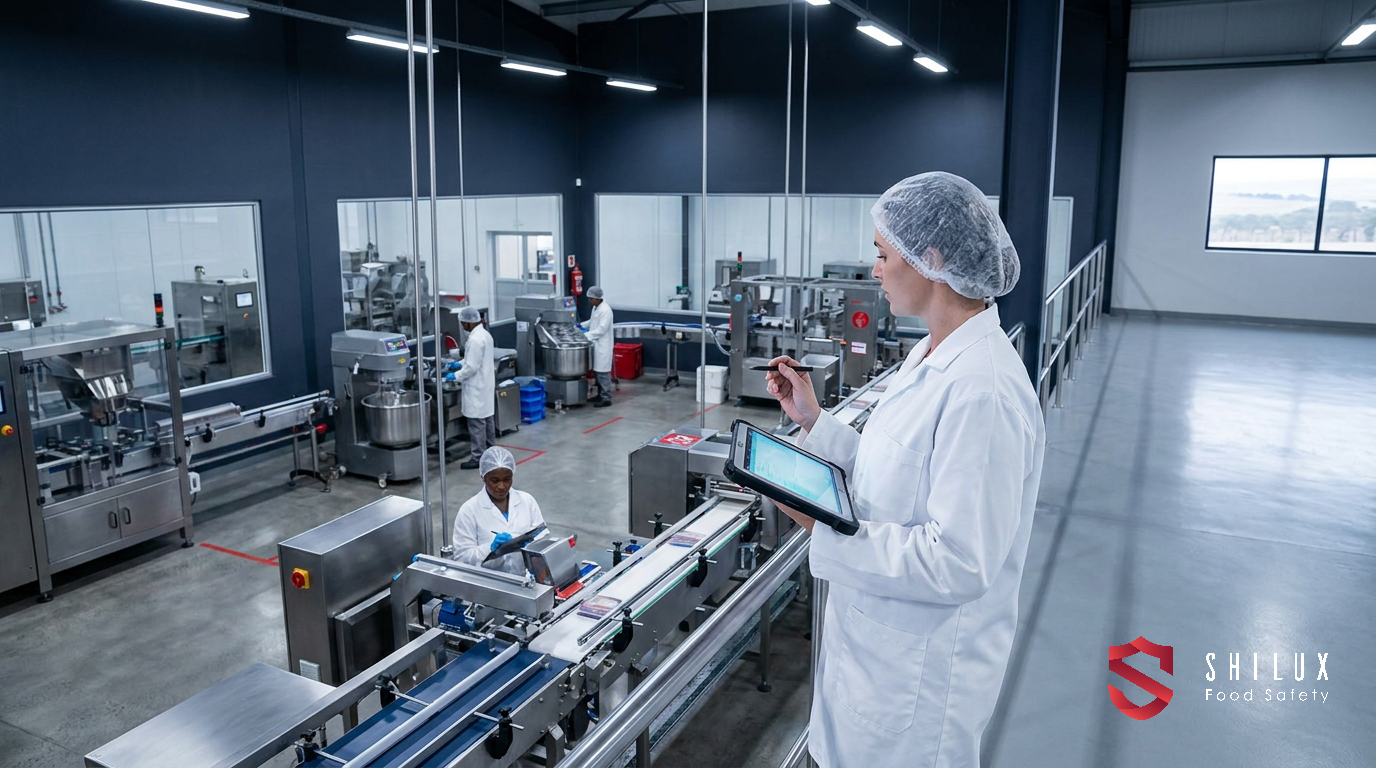
Securing the Digital Food Safety Record
Cybersecurity in digital compliance systems refers to the protection of electronic food safety records, automated monitoring data, and intellectual property from unauthorised access, alteration, or deletion. For South African food manufacturers, failing to secure these systems can lead to catastrophic data loss, breach of the Protection of Personal Information Act (POPIA), and the loss of GFSI certification due to compromised data integrity.
Key Takeaways
- Digital systems must ensure data integrity and prevent unauthorised modification to satisfy FSSC 22000 and BRCGS audit requirements.
- The Protection of Personal Information Act (POPIA) mandates the protection of employee and supplier data stored within your QMS.
- Cybersecurity is now a critical component of food defence strategies, particularly concerning the intentional sabotage of temperature logs or production records.
- Cloud-based systems generally offer superior security compared to local spreadsheets, provided they use encrypted protocols and multi-factor authentication.
- Regular backups and access control audits are no longer optional for maintaining a valid Certificate of Acceptability in a digital environment.
The Shift from Paper to Digital Compliance
For decades, South African food safety managers relied on the physical signature on a cleaning checklist or a temperature log to prove compliance with the Foodstuffs, Cosmetics and Disinfectants Act 54 of 1972. However, the transition to digital food traceability and paperless quality management systems (QMS) has introduced a new vulnerability: the cyber threat landscape. While digital systems eliminate the risks of illegible handwriting and "dry-labbing," they are susceptible to hacking, ransomware, and internal data tampering.
Regulatory requirements, specifically R.638 hygiene requirements, demand that records be kept and be accessible for inspection by an Environmental Health Practitioner. If a cyberattack encrypts your servers and renders your HACCP records inaccessible, your facility is technically in breach of the law, as you can no longer demonstrate that your critical control points (CCPs) are under control. The "Availability" requirement of R.638 means that if an inspector arrives and you cannot produce a digital record within a reasonable timeframe due to a system lockout, it is viewed with the same severity as missing paper logs.
Common Cyber Threats in the Food Factory
Data Tampering and Integrity Failures
In a digital system, the risk of a user changing a past temperature reading to hide a deviation is a major concern for auditors. GFSI-benchmarked standards like FSSC 22000 requirements place heavy emphasis on data integrity. If a system does not have a robust audit trail—a timestamped record of who changed what and when—the entire food safety management system (FSMS) can be found non-compliant during a internal audit.
Common failure modes include "Global Admin" accounts shared among the maintenance and QA teams. When a critical parameter like a pasteurisation hold-time is adjusted, a shared account makes it impossible to verify the competence or intent of the individual making the change. This lack of accountability is a significant finding during common food safety audit findings reviews.
Ransomware and Operational Downtime
Ransomware is particularly dangerous for SMEs. Imagine your food traceability system being locked by a hacker two hours before a major retailer audit. Without access to your batch records or approved supplier list, you cannot perform a mock recall, leading to an automatic audit failure and potential loss of contract.
In the South African context, many manufacturers rely on locally hosted servers that lack modern firewall protection. If a ransomware attack occurs, the business often faces a choice between paying the ransom or losing years of traceability records. Without these records, the facility cannot prove the safety of historical batches, potentially leading to a massive precautionary food recall vs withdrawal scenario if a quality issue is later identified.
Unauthorised Access and Food Defence
We often think of food defence as physical locks on silos or gates. However, cybersecurity is a vital part of TACCP (Threat Assessment Critical Control Point). An intruder who gains access to your automated pasteurisation software could lower the temperature setpoint remotely, leading to the distribution of unsafe products. This is why food defence TACCP must now include a review of digital access points.
Legal and Certification Requirements in South Africa
South African manufacturers operate under a dual layer of requirements: legal and voluntary. Legally, the Foodstuffs, Cosmetics and Disinfectants Act and its regulations do not specify the medium of record-keeping, but they mandate the accuracy and availability of those records. If you move to a digital system, you must ensure it is as reliable as the paper it replaces.
From a certification perspective, ISO 22000 documentation standards require the control of documented information. This includes protection against loss of integrity and unintended changes. The table below outlines how common digital practices map to specific food safety requirements.
| Cybersecurity Control | Food Safety Objective | Relevant Standard/Law | Operational Implementation Detail |
|---|---|---|---|
| User Access Levels | Prevents unauthorised editing of CCP limits. | Codex HACCP / ISO 22000 | QA Manager has 'Approve' rights; Operators have 'Read/Write' only. |
| Automated Audit Trails | Ensures data integrity and prevents "dry-labbing." | GFSI (BRCGS / FSSC 22000) | System logs every keystroke with a GMT timestamp and User ID. |
| Data Encryption | Protects sensitive supplier management data. | POPI Act | AES-256 encryption for data at rest and TLS 1.2 for data in transit. |
| Off-site Backups | Ensures record availability during inspections. | R.638 / SANS 10330 | Daily automated sync to a secure cloud bucket (e.g., Azure/AWS). |
| Multi-Factor Auth | Prevents credential theft and unauthorised login. | BRCGS Food Safety Culture | Requires a mobile app code for any remote access to the QMS. |
Practical Steps for QA Managers to Secure Digital Systems
1. Implement the Principle of Least Privilege
Not every employee needs the ability to delete or edit records. On the factory floor, a production operator should only have "entry" rights—the ability to record a value. Only the QA Manager or the Food Safety Team Leader should have the authority to verify or close a record. This limits the blast radius of both accidental errors and intentional sabotage. During a GMP audit, verify that tablets used on the floor do not have saved passwords that allow anyone to bypass the login screen.
2. Vulnerability Assessments in TACCP
When conducting your food defence threat assessment, include your IT infrastructure. Ask: Could a disgruntled employee or external hacker change our shelf-life data? Could they alter the HACCP critical limits in our digital plan? If the answer is yes, you need to implement stronger password policies or network segmentation. This is especially critical for sites moving toward IoT-enabled sensors that connect directly to the corporate Wi-Fi.
3. Supplier Due Diligence for Software Vendors
If you use a third-party software for supplier performance management, you are entrusting them with your data. As part of your supplier risk assessment, ask for their security credentials. Do they host data on reputable servers like AWS or Azure? Do they undergo independent security audits? Ensure the vendor provides a "Data Processing Agreement" that complies with POPIA requirements for South African entities.
The Importance of Data Integrity in Audits
During a BRCGS certification audit, the auditor will look for evidence that records have not been retroactively altered. Digital systems that allow users to change a record without leaving a "footprint" are a major red flag. If a deviation was recorded at 10:00 AM, and the correction was recorded at 10:05 AM, the system must show both entries. Attempting to overwrite the original error is a violation of the food safety culture principles of transparency and honesty.
To verify this internally, perform a mass balance on your data. Compare the digital logs of raw material usage against the physical stock counts. Discrepancies here often point to either physical theft or digital record manipulation to hide yield losses or ingredient substitutions, which links directly to food fraud mitigation.
The Role of Food Safety Culture in Cybersecurity
Technology alone cannot solve the problem. Food safety culture extends to how staff handle digital tools. Sharing passwords to tablets on the production line or leaving a terminal logged in while on a tea break are significant risks. Training should emphasize that a digital signature is a legal commitment, and the security of that signature is as important as hand-washing or wearing a hairnet.
QA Managers should integrate digital hygiene into their hygiene audits. Checking that tablets are docked securely and that staff are using their own logins provides a more holistic view of the site's compliance health. If staff feel that digital records are "just a computer thing" rather than a critical safety control, the likelihood of poor data entry increases, leading to issues identified in food safety culture problems assessments.
Expanded Cybersecurity Checklist for Digital Compliance
- Are all digital systems protected by unique user logins? (No shared "QA_Admin" accounts)
- Is there a formal procedure for revoking access when an employee leaves the company? (Must be part of the exit interview process)
- Are traceability records backed up daily to a secure, off-site location?
- Does the software provide a non-editable audit trail for all CCP examples?
- Has the Food Safety Team received training on identifying phishing emails that might target company data?
- Is the digital food defence plan reviewed at least annually or after significant system changes?
- Are automated sensors (PLCs) on a separate network from the office internet to prevent remote hacking?
- Is there a "Manual Override" procedure in case the digital system goes down, and is there a plan to re-enter that data?
Managing Non-Conformities and Root Cause Analysis
If a digital breach occurs—for example, if a week’s worth of metal detector logs are lost due to a server failure—this must be treated as a major non-conformity. You must immediately perform root cause analysis. Was the failure due to hardware, a lack of redundant backups, or a software bug? The resulting CAPA process should focus on ensuring that digital records are never lost again, as this is a critical requirement for maintaining your Certificate of Acceptability.
When documenting the CAPA effectiveness verification, look beyond the technical fix. If the root cause was a staff member disabling a firewall to stream video on a control room computer, the corrective action must address the behavioural element through updated food safety culture leadership training. Simply fixing the firewall is a correction; preventing the staff bypass is a corrective action.
Common Failure Modes in Digital Food Safety
1. The "Sync" Failure: Tablets used in cold storage or areas with thick concrete walls often lose Wi-Fi. If the device doesn't have an offline mode, data is lost when the operator moves to a new area. Fix: Use hardware that supports local caching and automated syncing once a connection is re-established.
2. Generic Logins: Using "Shift1" as a login for ten different people. This makes it impossible to conduct a proper internal audit vs external audit investigation into who signed off on a non-conforming batch. Fix: Implement individual PINs or RFID badges for login.
3. Legacy OS Vulnerabilities: Running food safety software on old Windows XP or Windows 7 machines that are no longer receiving security patches. These are prime targets for ransomware. Fix: Include IT hardware in the prerequisite programmes (PRP) maintenance schedule.
Conclusion
Digital compliance systems offer immense benefits in efficiency and accuracy, but they are not a "set and forget" solution. For South African manufacturers, the intersection of food safety and cybersecurity is the new frontier of risk management. By treating digital records with the same level of scrutiny as physical ingredients, you can protect your brand, your customers, and your certification status.
At Shilux, we help manufacturers navigate the complexities of modern compliance through expert food safety consulting and specialized training. If you are looking to transition to a secure, paperless environment, our QMSURE system is designed with the highest standards of data integrity and cybersecurity to ensure your facility remains audit-ready and legally compliant. Whether you are preparing for a readiness audit or seeking to improve your FSSC 22000 documentation, securing your digital record is the first step toward long-term operational resilience.