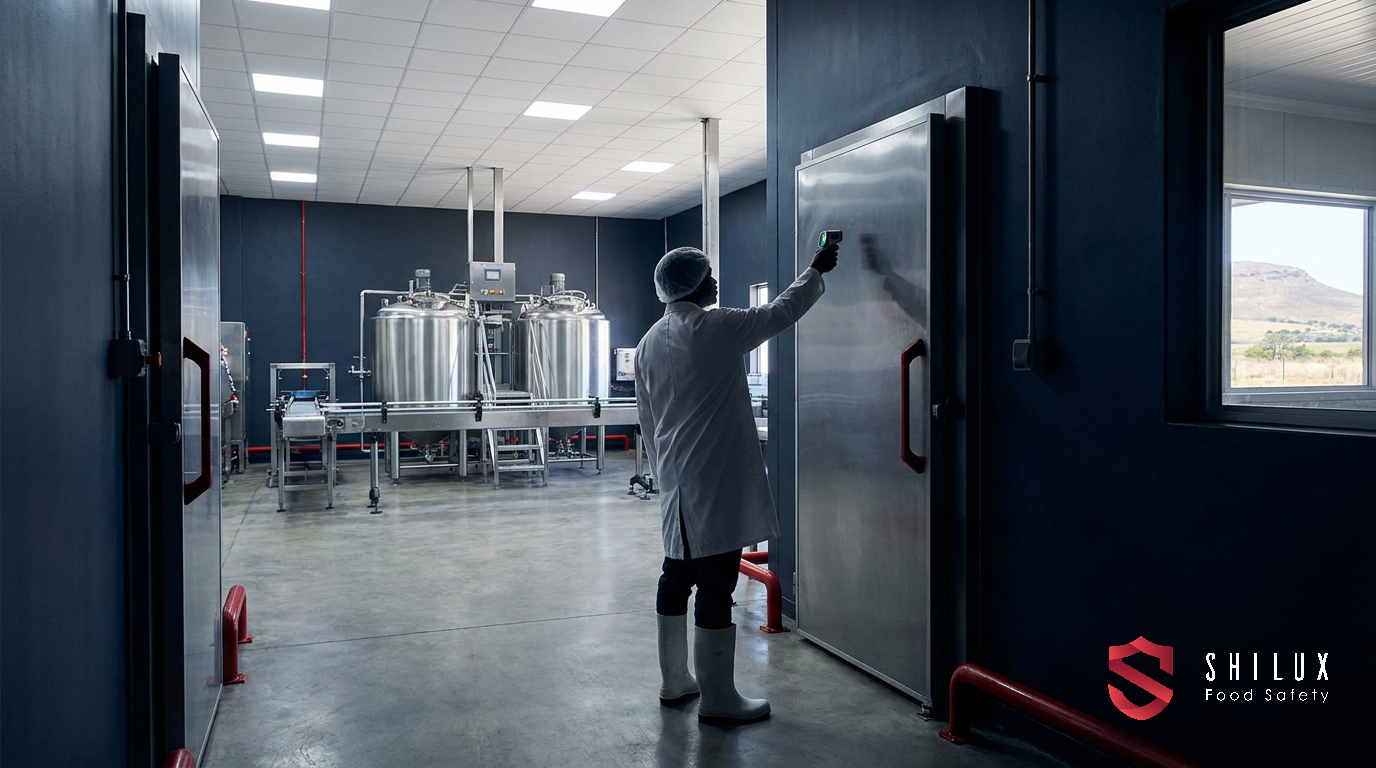
Load-shedding and unannounced power outages compromise food safety by disrupting the continuous cold chain, halting critical heating processes, and interrupting automated sanitation cycles. These disruptions can allow for rapid microbial growth and chemical cross-contamination, directly impacting a manufacturer’s ability to comply with the Foodstuffs, Cosmetics and Disinfectants Act 54 of 1972 and the R.638 hygiene requirements. In the South African context, where energy instability is a chronic operational factor, food safety management must shift from reactive crisis management to proactive risk mitigation.
Key Takeaways
- Cold Chain Integrity: Maintaining temperatures below 5°C is a legal requirement under R.638 for perishable goods; deviations during outages require immediate risk-based disposition.
- Process Control: Power cuts during Critical Control Points (CCPs), such as pasteurisation, necessitate robust rework or disposal procedures to prevent pathogen survival.
- Sanitation Risks: Interrupted CIP (Clean-in-Place) cycles can lead to biofilm formation and chemical residues if not re-validated.
- Regulatory Liability: A Certificate of Acceptability (CoA) can be revoked if a facility cannot demonstrate adequate hygiene control during utility failures.
- HACCP Evolution: Food Safety Management Systems (FSMS) must treat power outages as a likely hazard rather than a rare emergency.
The Regulatory Reality: R.638 and the Certificate of Acceptability
In South Africa, the foundation of food hygiene is R.638 regulations. These regulations mandate that food premises must be operated in a way that prevents the contamination of food. Specifically, Regulation 8 requires that the cold chain for perishable foodstuffs be maintained at all times. When load-shedding occurs, the onus is on the person in charge to prove that the safety of the food has not been compromised.
During an inspection by an Environmental Health Practitioner (EHP), a manufacturer must be able to produce temperature logs that show continuity during power outages. A common failure mode in South African facilities is the "missing data" gap—where digital loggers powered by the mains stop recording during a blackout. If the power failure results in a lack of potable water or the inability to clean equipment, the facility technically no longer meets the requirements for its Certificate of Acceptability. Operating without these controls in place is a criminal offence under the Act. To avoid this, sites must ensure their food premises requirements are met via secondary power for essential monitoring equipment.
Microbial Growth and Temperature Abuse
The primary concern during load-shedding is the "Danger Zone" (between 5°C and 60°C). Many South African manufacturers rely on large industrial chillers or walk-in freezers. While these units have some thermal mass, the ambient temperatures in South Africa, particularly during summer, mean that internal temperatures can rise to unsafe levels within two to four hours. The "why" behind this is simple: Bacillus cereus and Staphylococcus aureus can reach infectious levels rapidly when refrigeration fails, especially in prepared foods or dairy products.
From a HACCP perspective, temperature control is often a Critical Control Point (CCP). If the power fails, the monitoring of that CCP is often lost unless the facility has invested in battery-backed data loggers. Without data, the manufacturer cannot prove the food is safe, leading to potentially massive product losses or, worse, a public health incident. This necessitates a thorough HACCP hazard analysis that specifically addresses utility failure as a biological hazard.
The Risk of "Silent" Failures
While a total blackout is obvious, the moments following power restoration are equally dangerous. Power surges can damage compressor motors or calibration settings on temperature probes. A probe that reads 4°C when the actual temperature is 9°C is a significant food safety risk that might go unnoticed until the next internal audit or customer complaint. Facilities should implement a "Post-Outage Verification" protocol, checking probe accuracy against a calibrated handheld thermometer immediately after power is restored.
Operational Detail: Managing CCPs During Outages
For manufacturers involved in cooking, blanching, or pasteurisation, an outage mid-cycle is a high-risk event. If a batch of milk or juice is halfway through a heat treatment when the boilers or electric heaters cut out, the product enters a state of high vulnerability. Pathogenic bacteria like Listeria monocytogenes or Salmonella may survive if the lethality step is not completed. A robust HACCP plan must include specific "stop-loss" procedures for these events.
| Scenario | Immediate Risk | Operational Corrective Action | Documentation Requirement |
|---|---|---|---|
| Outage during cooking/pasteurisation | Pathogen survival | Quarantine product. Conduct a risk assessment for full reheat or disposal. | CAPA Incident Report + Reheat logs. |
| Outage during CIP cycle | Chemical residue or biofilm | Manually flush lines. Restart the entire CIP cycle once power/water is restored. | Sanitation log with "restart" signature. |
| Outage in cold storage (>4 hours) | Microbial proliferation | Check core temperatures. If >5°C for >2 hours, move to high-risk processing or discard. | Continuous temp log printout. |
| Loss of water pressure | Inability to wash hands/surfaces | Cease all open-product handling immediately. | Production stoppage log. |
| Outage during packing (Sealers) | Loss of vacuum/Modified Atmosphere | Check seal integrity on all packs in the machine at time of failure. | Seal integrity test records. |
Sanitation and Prerequisite Programmes (PRPs)
Power outages often affect more than just the production line; they affect the prerequisite programmes (PRPs) that support the entire FSMS. For instance, if the pumps for the effluent system or the water purification plant stop working, the facility can quickly become unhygienic. Stagnant water in drainage systems can become a breeding ground for Listeria, which may then be aerosolized when power (and ventilation) returns.
One often overlooked area is Biofilm formation. In modern facilities, Clean-in-Place (CIP) systems are programmed to move water and chemicals at specific velocities and temperatures. If a cycle is interrupted, stagnant water and organic matter remain in the pipes. If the power is out for several hours, bacteria can begin to attach to the stainless steel surfaces, forming biofilms that are much harder to remove than standard soil. Simply resuming the cycle where it left off is often insufficient. Quality managers must mandate a full re-wash, potentially using a higher concentration of alkaline detergent to break down any initial protein attachment during the downtime.
Impact on Traceability and Inventory
During the chaos of a power outage, manual record-keeping often lapses. Staff may forget to record batch numbers or time-stamps for product movements between cold rooms. This directly compromises batch traceability. If a facility cannot pinpoint which batches were exposed to temperature abuse, they may be forced to discard an entire day's production rather than just a few pallets. Integrating digital food traceability tools with offline capabilities ensures that data is captured even when the local area network is down.
Audit and Certification Impacts (FSSC 22000 & BRCGS)
For those certified under GFSI-benchmarked standards, such as FSSC 22000 or BRCGS certification, the requirements are even more stringent. Auditors will look for evidence that the business has conducted a formal risk assessment on the impact of utility failures. This is no longer considered an "Act of God" in South Africa; it is a foreseeable operational reality. In recent months, common food safety audit findings have highlighted a lack of "Emergency Preparedness" specifically regarding multi-hour power failures.
During a GMP audit, the auditor will examine how the facility manages the transition between grid power and backup power. Are there gaps in the monitoring? Does the backup generator support the lighting in the QA lab to ensure visual inspections can continue? If the generator fails to start, is there a food recall plan ready in case compromised product was accidentally shipped? Failure to address these points leads to Major Non-Conformities under the "Resource Management" and "Emergency Preparedness" clauses of ISO 22000.
Root Cause Analysis of Outage-Related Failures
When a food safety incident occurs due to power loss, facilities often incorrectly identify "load-shedding" as the root cause. However, effective root cause analysis should go deeper. Using the 5 Whys technique, a team might find:
- Finding: Milk spoiled in the chiller during a 4-hour outage.
- Why? The chiller temperature rose to 12°C.
- Why? The backup generator failed to switch on for the refrigeration circuit.
- Why? The generator had not been serviced or tested under load for six months.
- Root Cause: Inadequate maintenance schedule for backup utility systems (PRP failure).
By identifying these internal systemic failures, the company can apply a CAPA process that actually prevents recurrence, such as installing automated transfer switches or increasing the frequency of generator load tests.
Load-Shedding Response Checklist for QA Managers
Use the following checklist to evaluate your site's readiness for prolonged or frequent power disruptions:
- Continuous Monitoring: Are temperature loggers equipped with independent power sources (batteries) to record data during blackouts? Refer to your traceability records to ensure no gaps exist.
- Water Security: Do you have a header tank or backup supply of potable water to maintain handwashing and basic sanitation? Without water, you cannot maintain food premises hygiene requirements.
- Equipment Restart Procedures: Are there written SOPs for how to safely restart production lines, including mandatory clearing of partially processed product?
- Lighting: Is emergency lighting sufficient in all high-care areas to prevent physical contamination (e.g., glass breakage) during a sudden outage?
- Supplier Management: Have you conducted supplier audits to ensure your raw material providers are also maintaining the cold chain? Use a supplier evaluation checklist to verify their backup capabilities.
- Training: Do floor staff know exactly what to do when the lights go out, or do they wait in the dark with open product exposed? This is a critical component of food safety culture.
- Product Disposition: Is there a clear decision tree for when to "rework" vs "discard" product that has been temperature abused?
The Economic Cost of Failure
The cost of a food safety failure during load-shedding far exceeds the cost of a generator or solar installation. A single batch of contaminated product reaching the market can lead to a national food recall, which involves not just the cost of logistics but devastating brand damage and legal liability. Beyond the direct food recall cost, companies face the risk of losing retail listings if they cannot guarantee supply chain stability. In the South African context, where consumer trust is fragile, the ability to guarantee safety despite a failing power grid is a significant competitive advantage.
Internal Audit Practice for Utility Failure
During your next internal audit, simulate a power outage. Do not just check if the lights stay on; check if the staff follow the "open product" protection protocols. Verify that the time of the outage is noted in the production log and cross-reference this with the temperature monitoring software. If there is a discrepancy between when the power went out and when the deviation was recorded, it indicates a failure in your FSSC 22000 documentation system. This "stress testing" of the FSMS is the only way to ensure resilience.
Conclusion
Load-shedding is a multifaceted threat to food safety, affecting temperature control, sanitation, and process validation. By moving beyond reactive measures and integrating power-failure risks into the formal HACCP plan, South African food manufacturers can protect their consumers and their compliance status. Documentation, data continuity, and clear operational procedures are the only ways to prove that food remains safe when the lights go out.
Maintaining compliance during utility disruptions requires a robust management system and a proactive culture. Whether you need a gap audit to identify vulnerabilities in your current load-shedding response or want to move to a paperless system like QMSURE to ensure data integrity during outages, Shilux is here to help. Contact our food safety consulting team today to secure your facility's future.