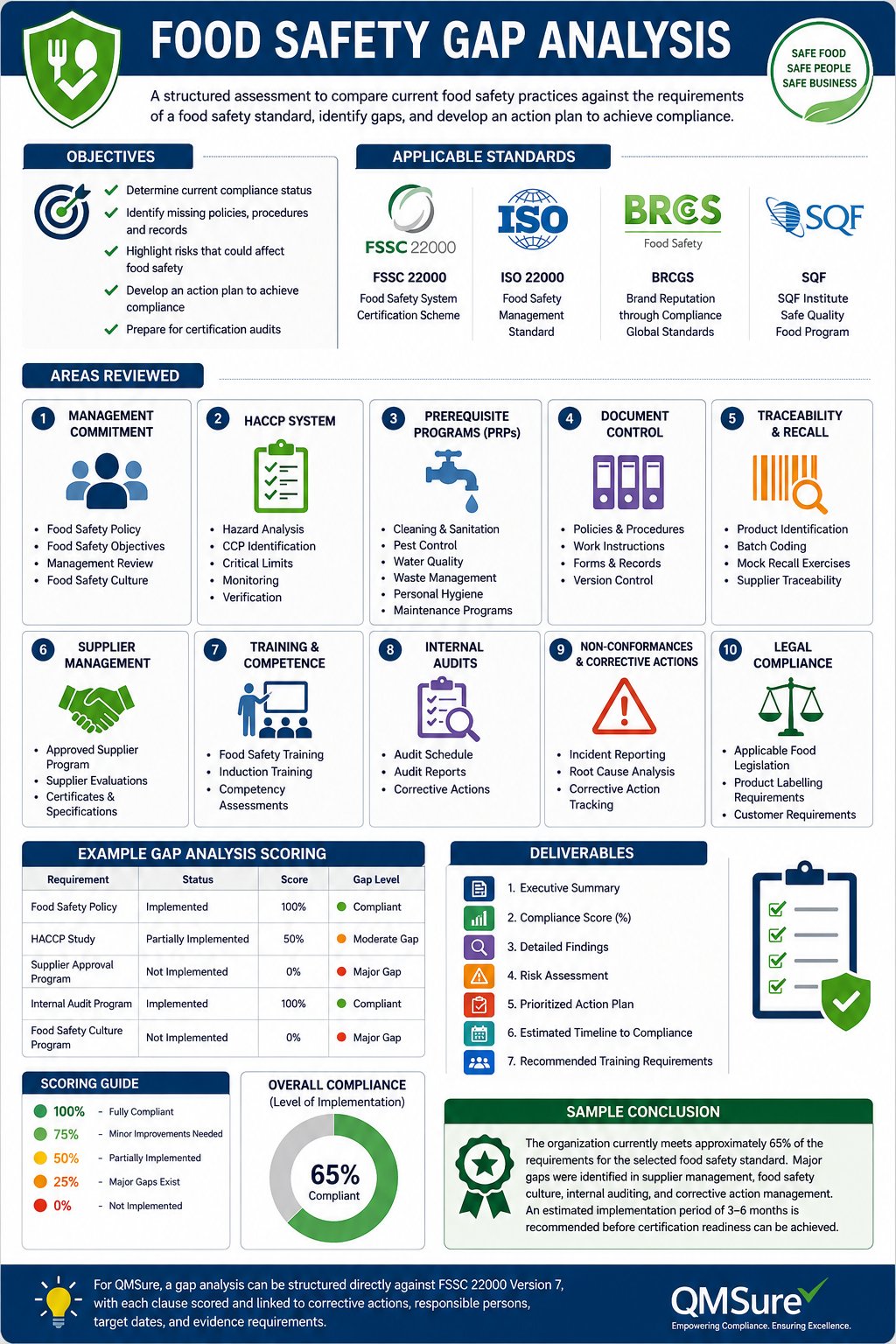
The average cost of a food recall reached over R185 million in 2025, a figure that excludes the long-term damage to brand reputation and consumer trust. For South African producers, the pressure to maintain rigorous standards is intensifying, especially with the release of FSSC 22000 Version 7 in May 2026. You likely understand the frustration of interpreting complex BRCGS clauses or the anxiety that stems from managing a mountain of paper-based documentation. Conducting a formal food safety gap analysis is the most reliable way to ensure these vulnerabilities don't lead to a devastating audit failure.
This guide will help you master the methodology of identifying compliance weaknesses before they become liabilities. By systematically evaluating your current operations against international benchmarks, you can transform your facility into a highly organised, compliant environment. We provide a clear roadmap to help you prepare for certification with confidence, reducing your risk of non-conformance whilst ensuring your quality management system is ready for the upcoming transition periods. We'll examine the specific steps required to bridge the gap between your current operational reality and total audit readiness.
Key Takeaways
- Understand the critical role of a formal diagnostic assessment in bridging the gap between current operational reality and international standards like FSSC 22000.
- Master a structured five-phase methodology to conduct a professional food safety gap analysis that identifies both documentation and operational weaknesses.
- Distinguish between a gap analysis and an internal audit to ensure you are using the correct tool for proactive readiness versus compliance verification.
- Learn how to apply a risk-based lens to prioritise findings and develop SMART corrective action plans that address the most urgent vulnerabilities first.
- Recognise the strategic advantage of utilising objective third-party consultants and digital quality systems to streamline your path to international certification.
What is a Food Safety Gap Analysis and Why is it Critical?
A food safety gap analysis serves as a formal diagnostic tool designed to measure the distance between your current Food Safety Management System (FSMS) and a specific benchmark. It isn't merely a checklist; it's a strategic evaluation that identifies where your protocols fail to meet the rigorous demands of international standards or local legislation. For South African businesses, this process is essential to reconcile the baseline requirements of Regulation R638 with the more stringent expectations of Global Food Safety Initiative (GFSI) recognised schemes.
The process operates as a practical application of a broader food safety risk analysis; it allows management to visualise vulnerabilities before they manifest as contaminated products or failed audits. Identifying these "blind spots" early protects your brand reputation amongst local retailers and high-value export markets. In the South African market, a single major non-conformance during a retail audit can result in the immediate suspension of supply agreements, making this diagnostic process a critical safeguard for business continuity.
The Core Objectives of a Gap Assessment
Evaluating the effectiveness of current Prerequisite Programmes (PRPs) is a primary goal. If your cleaning schedules, pest control measures, or personal hygiene protocols are insufficient, the entire FSMS is compromised. A professional food safety gap analysis also helps gauge the maturity of your food safety culture. This is increasingly vital as the upcoming 2027 version of ISO 22000 will place a heavier emphasis on employee behaviour and shared responsibility. Finally, the analysis determines the precise resource requirements, such as capital expenditure or specialised training, needed to achieve a new certification like BRCGS.
Regulatory vs. Certification Benchmarks
Distinguishing between mandatory and voluntary standards is a key outcome of the assessment. Whilst South African health inspectors enforce R638, global trade often requires compliance with schemes like FSSC 22000 or GLOBALG.A.P. Many local retailers also impose their own proprietary food safety standards on suppliers within local supply chains. A comprehensive gap analysis ensures your facility remains compliant with national health regulations whilst simultaneously meeting the sophisticated demands of the global supply chain, ensuring you don't overlook any specific retailer requirements.
A 5-Step Methodology for Conducting a Professional Gap Analysis
A rigorous food safety gap analysis isn't a casual inspection; it's a systematic evaluation that requires a disciplined, evidence-based approach. To move beyond a simple tick-box exercise, organisations must follow a methodical five-phase process that scrutinises every layer of the food safety management system. This methodology ensures that when an external auditor arrives, there are no surprises regarding your facility's compliance status.
Step 1: Defining Your Scope and Team
The first phase involves selecting the specific benchmark standard that aligns with your business objectives, such as BRCGS or FSSC 22000. It's crucial to define the physical boundaries of the assessment and the product categories involved. Appointing an objective lead assessor is vital for accuracy; many organisations find that a third-party gap assessment provides the unbiased perspective necessary to identify systemic failures. The team must also be well-versed in the HACCP governance framework to ensure that the technical foundations of the system are robust and legally defensible.
Step 2: The Physical Site Walk-Through
Once the document review is complete, the focus shifts to the factory floor. This phase involves observing the actual flow of personnel and materials to pinpoint potential cross-contamination risks that might not be evident on paper. We examine the condition of equipment, facility hygiene, and the efficacy of sanitation protocols. It's common to find that daily operations have drifted away from written procedures; this walk-through is designed to catch those deviations before they result in a major non-conformance. If you're unsure how to align your physical operations with complex standards, engaging in professional food safety consulting can provide the necessary technical clarity.
Step 3: Interviewing and Verifying Competence
A compliant system is only as strong as the people operating it. We engage directly with production staff to test their understanding of Critical Control Points (CCPs) and their roles in maintaining safety. This isn't just about technical knowledge; it's about assessing the maturity of the food safety culture. Following these interviews and observations, the food safety gap analysis concludes with a final report where findings are categorised by severity:
- Critical Gaps: Issues that pose an immediate risk to food safety or violate South African regulatory requirements.
- Major Gaps: A significant failure to meet a specific clause of the chosen international standard.
- Minor Gaps: Small deviations or administrative errors that don't compromise the integrity of the overall system but require correction.
This structured output allows management to prioritise resources effectively, ensuring that the most urgent vulnerabilities are addressed first.

Gap Analysis vs. Internal Audit: Understanding the Differences
Quality managers often conflate these two processes, yet they serve fundamentally different roles in a facility's compliance lifecycle. An internal audit is a verification activity; it asks whether the facility is following its own established procedures. In contrast, a food safety gap analysis is a diagnostic exercise. It asks whether those procedures are actually sufficient to meet the requirements of a specific standard. Understanding this distinction is vital for effective resource allocation.
Timing serves as the primary differentiator. A gap analysis should always precede the implementation of a new system or a major standard update. It provides the strategic roadmap for improvement and resource planning. Whilst an internal audit identifies where a system is failing, the gap analysis identifies what is entirely missing. This makes it an invaluable tool for senior management when determining where to invest in facility upgrades or staff development. The two processes complement each other by ensuring the system is both well-designed and consistently executed.
When to Choose a Gap Analysis
This tool is most effective when your organisation faces significant change. For example, transitioning to FSSC 22000 Version 7 requires a fresh look at your current state compared to the new requirements. It's also the correct choice when commissioning a new production line or assessing a potential supplier's readiness before they enter your South African supply chain. It provides the clarity needed to build a system from the ground up without wasting resources on unnecessary measures.
The Role of the Internal Audit
Internal auditing is a recurring requirement for those maintaining BRCGS Global Standards or other GFSI-recognised schemes. Its primary purpose is to provide evidence of continuous improvement and to verify that staff consistently follow food safety protocols over time. It ensures that the high standards established during your initial food safety gap analysis don't degrade into complacency. By identifying non-conformances internally, you can correct them before they are flagged by an external certification body.
Prioritising Findings and Developing a Corrective Action Plan (CAP)
Identifying weaknesses through a professional food safety gap analysis is only the first stage of the journey toward certification. The true value of the assessment lies in the subsequent development of a robust Corrective Action Plan (CAP). This plan must be more than a simple to-do list; it should serve as a strategic document that outlines how the organisation will mitigate risks and close compliance holes before an external audit occurs. Without a structured approach to remediation, the findings of the analysis remain academic rather than actionable, leaving the facility vulnerable to the high costs of non-conformance.
A raw list of findings can be overwhelming for quality teams. You must apply a risk-based lens to determine the urgency of each item, ensuring that resources are directed toward the most significant threats to consumer safety and regulatory compliance first. This prioritisation is especially critical in South Africa's high-stakes regulatory environment, where failing to address a critical gap can lead to immediate legal repercussions or the loss of key retail contracts. By categorising findings, management can make informed decisions about capital expenditure and staff allocation.
Risk-Based Categorisation of Gaps
Not all findings carry the same weight during a food safety gap analysis. We categorise gaps based on their potential impact on product safety and certification status. Critical gaps represent immediate threats to food safety or direct violations of South African health regulations, such as R638. These require instant intervention and often involve stopping production until the risk is mitigated. Major gaps are significant failures in meeting the requirements of standards like FSSC 22000 or BRCGS, which would inevitably lead to a failed certification audit. Minor gaps are isolated incidents or administrative oversights that offer opportunities for further system optimisation but don't immediately threaten the integrity of the overall FSMS.
Building the Roadmap to Certification
Closing these gaps requires the development of SMART (Specific, Measurable, Achievable, Relevant, Time-bound) corrective actions. Each action must be assigned to a specific individual with a defined deadline and a clear budget for any necessary structural or process improvements. It's essential to conduct a root cause analysis for every major finding. Addressing the symptom rather than the systemic weakness ensures that the problem won't recur during the next audit cycle. Managers should monitor progress through regular follow-up meetings and update all documentation to reflect the improved processes. If you need assistance in developing a defensible remediation strategy, our team provides expert HACCP consulting to help you navigate these complex requirements with precision.
Streamlining Compliance with Professional Support and Digital Tools
Self-assessment often lacks the critical objectivity required to identify deeply embedded systemic failures. Whilst internal teams possess intimate knowledge of daily operations, they may overlook subtle non-conformances due to familiarity or "audit blindness." Engaging an external partner for a food safety gap analysis provides a fresh, unbiased perspective that ensures every clause of your chosen standard is scrutinised with professional rigour. This objective approach is particularly vital when preparing for high-stakes international certifications where the cost of failure is significant.
The transition from a static gap report to a live compliance system is where many businesses falter. Manual, paper-based documentation is inherently prone to error and often becomes a significant administrative burden during external audits. Moving toward digital management allows quality teams to focus on safety rather than filing. By integrating professional guidance with modern technology, South African producers can maintain a state of permanent audit readiness without the traditional overhead of manual record-keeping.
The Value of Shilux Food Safety Consulting
Our consulting services provide more than just a list of findings; we deliver a strategic blueprint for success. We draw on years of experience in FSSC 22000 Implementation and BRCGS Readiness across the South African food industry. We understand the nuances of local supply chains and the specific challenges of aligning with R638 whilst meeting global benchmarks. This specialised knowledge allows us to provide actionable insights that go beyond generic advice, offering practical solutions tailored to your facility’s unique operational constraints and product categories.
Digital Transformation with QMSure
Our QMSure Paperless Quality System addresses the inherent risks of manual systems by digitising your entire FSMS. It automates the tracking of corrective actions and provides a real-time monitoring dashboard for management. This digital transformation reduces the risk of lost or incomplete records and ensures that your food safety gap analysis findings are addressed promptly. By moving away from paper-based checklists, you improve operational efficiency and provide external auditors with clear, easily accessible evidence of your compliance history.
Long-term sustainability depends on more than just software; it requires a sustained commitment to Food Safety Training. We help you build a culture where safety is a shared responsibility, ensuring that your staff remain competent as standards evolve. By combining expert consulting with digital tools, you create a resilient management system that protects your brand and facilitates growth in both local and export markets.
Securing Your Position in the Global Food Supply Chain
Achieving international certification is a significant milestone that requires more than just administrative effort; it demands a strategic alignment of your entire operational culture. By mastering a structured methodology and prioritising findings through a risk-based lens, you move beyond simple compliance to a state of sustained readiness. A professionally conducted food safety gap analysis ensures your facility is prepared for the rigorous demands of FSSC 22000 or BRCGS, protecting your brand from the devastating costs of non-conformance.
Shilux Food Safety provides the expertise needed to navigate this complex regulatory landscape. Our qualified professionals possess extensive GFSI experience and offer national coverage across South Africa, ensuring your facility meets both local R638 and global benchmarks. As the creators of the QMSure paperless quality system, we help you replace inefficient manual documentation with a streamlined digital dashboard. Contact Shilux Food Safety today to schedule your professional gap analysis and take the first step toward a more organised and successful future. We look forward to helping you achieve your certification goals with confidence.
Frequently Asked Questions
What is the primary purpose of a food safety gap analysis?
The primary purpose is to serve as a formal diagnostic tool that identifies discrepancies between your current food safety management system and a specific benchmark standard. It provides a strategic roadmap for resource allocation and remediation, ensuring that all vulnerabilities are addressed before you commit to a formal certification audit. This proactive approach helps prevent costly non-conformances and protects your brand reputation.
How often should my food business conduct a gap assessment?
You should conduct an assessment whenever there is a significant change to your operational environment or the regulatory landscape. This includes transitioning to new standard versions, such as FSSC 22000 Version 7, or when commissioning new production lines. It's also advisable to perform a gap assessment before onboarding new high-risk suppliers to ensure they meet your facility's safety requirements.
Can our own internal staff perform a reliable gap analysis?
Whilst internal staff can perform self-assessments, they often lack the necessary objectivity to identify systemic "blind spots" due to their daily familiarity with the facility. Professional consultants provide an unbiased perspective and technical expertise that internal teams might miss. This external distance is essential for a truly reliable food safety gap analysis that stands up to the scrutiny of international auditors.
What is the difference between a gap analysis and a mock audit?
A gap analysis focuses on identifying missing components or structural weaknesses during the system's development or transition phase. In contrast, a mock audit is a full simulation of the certification process, performed once the system is fully implemented to test its effectiveness. One identifies what needs to be built, whilst the other verifies that the built system is functioning as intended under audit conditions.
Which food safety standards require a formal gap analysis?
Whilst not always a mandatory clause within the standards themselves, a formal food safety gap analysis is highly recommended for all GFSI-recognised schemes, including BRCGS, FSSC 22000, and GLOBALG.A.P. It's considered a best-practice prerequisite for any South African business aiming to align with sophisticated retail standards or enter high-value export markets with confidence.
How long does a typical food safety gap analysis take to complete?
The duration depends on the size of your facility and the complexity of the chosen standard. A typical assessment for a medium-sized South African food manufacturer usually takes between two and four days. This timeframe includes the initial document review, the on-site physical walk-through, staff interviews, and the final categorisation of findings into a formal report.
What happens if a critical gap is identified during the assessment?
Critical gaps represent immediate threats to consumer safety or direct violations of South African health regulations like R638 and require instant intervention. You must halt the affected processes, conduct a thorough root cause analysis, and implement a permanent corrective action. These findings are prioritised at the top of your remediation plan to ensure the risk is mitigated before any further production occurs.
Should we document the findings of our gap analysis for external auditors?
Yes, maintaining a record of the findings and your subsequent remediation efforts is highly beneficial. Documenting the process demonstrates management commitment and a proactive food safety culture to external auditors. It provides tangible evidence of continuous improvement, showing that your organisation actively seeks to identify and close vulnerabilities rather than merely waiting for an audit to find them.