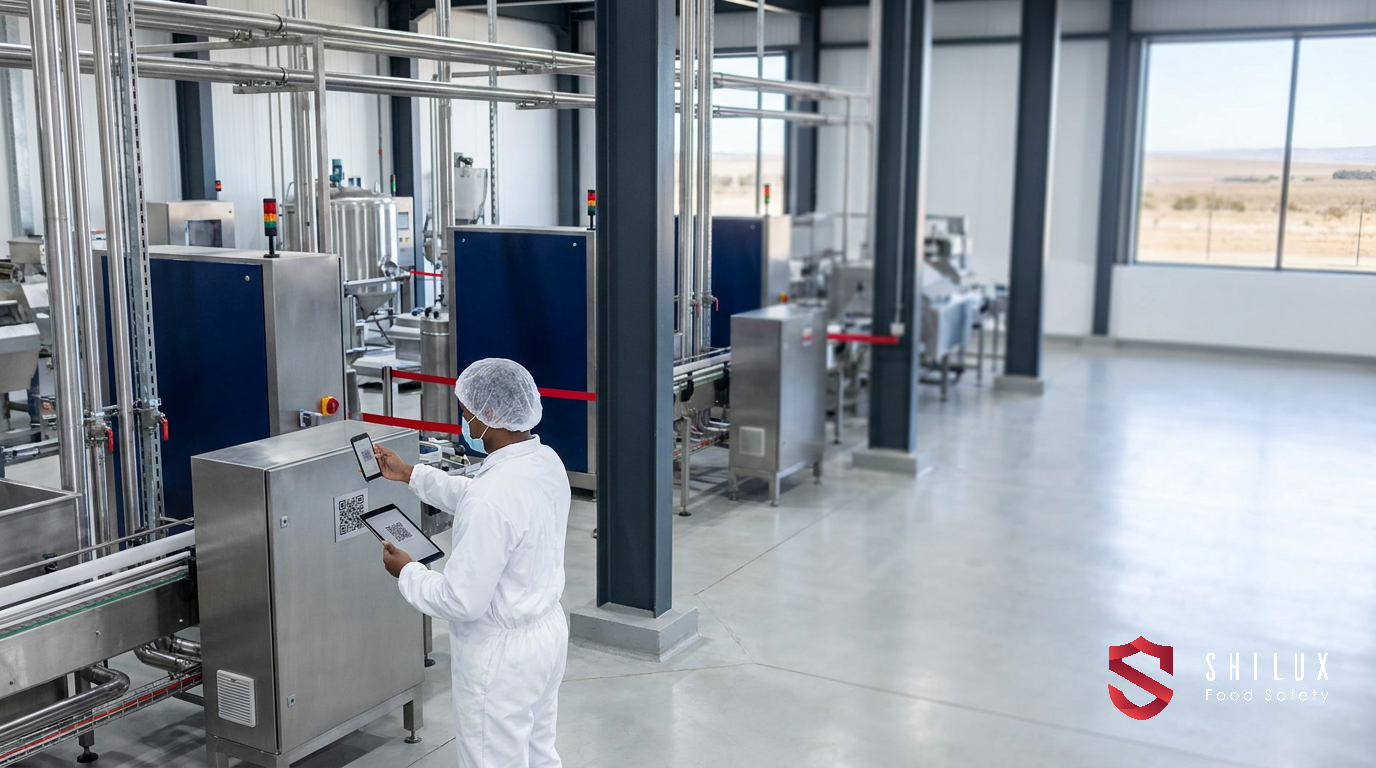
Transitioning to Digital Food Safety Compliance
The future of digital food safety management systems (FSMS) lies in the transition from reactive, paper-heavy documentation to proactive, real-time data ecosystems that integrate compliance directly into the manufacturing workflow. For South African manufacturers, this shift enables precise adherence to the Foodstuffs, Cosmetics and Disinfectants Act 54 of 1972 and R.638 hygiene requirements, while significantly reducing the administrative burden of maintaining audit-ready records for GFSI-benchmarked standards.
Key Takeaways
- Real-Time Verification: Digital systems replace retrospective paper checks with immediate validation of CCPs and PRPs.
- Regulatory Alignment: Automated workflows ensure mandatory South African compliance, including R.638 and Certificate of Acceptability (CoA) maintenance.
- Audit Readiness: Digital platforms like QMSURE reduce audit preparation time by centralising traceability records and CAPA evidence.
- Data-Driven Culture: Transitioning to digital tools fosters a stronger food safety culture by providing staff with user-friendly, accountable interfaces.
- Supply Chain Transparency: Enhanced digital integration simplifies supplier management and vulnerability assessments.
The Legislative and Certification Landscape in South Africa
In the South African context, food safety is governed by a tiered structure of legal requirements and voluntary certifications. At the foundation is the Foodstuffs, Cosmetics and Disinfectants Act 54 of 1972. Under this Act, Regulation R.638 sets out the enforceable hygiene requirements for food premises and the transport of food. Legally, every food manufacturer must possess a valid Certificate of Acceptability (CoA) issued by a local Environmental Health Practitioner (EHP).
While R.638 provides the legal baseline, commercial success often requires adherence to higher-level frameworks. This includes HACCP (SANS 10330) and GFSI-benchmarked standards such as FSSC 22000 and BRCGS. The future of digital systems is designed to bridge the gap between these requirements, ensuring that a single digital entry satisfies both the local EHP and an international third-party auditor.
Comparison: Paper-Based vs. Digital FSMS
| Feature | Traditional Paper Systems | Digital FSMS (e.g., QMSURE) |
|---|---|---|
| Data Entry | Manual, prone to transcription errors and back-filling. | Real-time, time-stamped, and validated at source. |
| Traceability | Hours or days spent scouring filing cabinets. | Instantaneous, multi-level batch traceability within minutes. |
| Alerting | Relies on a supervisor noticing a deviation on a form. | Instant SMS or email alerts when Critical Limits are breached. |
| Non-Conformities | Detached CAPA logs, often updated weeks later. | Integrated CAPA process linked directly to the incident record. |
| Document Control | Physical binders with potential for obsolete versions. | Centralised cloud storage with strict version control. |
Operational Reality: Moving Beyond the Clipboard
For a QA Manager in a high-pressure environment—such as a meat processing plant or a high-risk bakery—the daily routine involves managing hundreds of checks. These include cold-chain monitoring, cleaning checklists, glass and hard plastic registers, and pest control logs. In a paper system, these are often "completed" at the end of a shift, which introduces significant risk.
A digital system changes the behaviour on the factory floor. By using tablets or fixed terminals, operators are forced to record data as it happens. For example, if a pasteurisation temperature falls below the limit defined in the HACCP plan, the digital system can prevent the operator from proceeding until a corrective action is logged. This moves food safety from a "reporting" function to a "control" function.
Practical Implementation: The Digital CCP Log
In a South African dairy processing environment, a Critical Control Point (CCP) such as the pasteuriser must be monitored at fixed intervals. In a paper system, "dry-labbing"—where an operator fills in the logs at 4:00 PM for the entire day—is a common failure mode. A digital system eliminates this through time-stamped entries and GPS or Bluetooth proximity verification. If the temperature exceeds the HACCP critical limit, the system immediately triggers a notification to the QA supervisor. This ensures that the "Corrective Action" isn't just a tick-box on a sheet, but a documented process including product hold, re-processing, or disposal.
Managing PRPs Digitally
Prerequisite Programmes (PRPs) are the foundation of any system. Digital tools excel at managing the scheduling of these tasks. Instead of a master cleaning schedule hanging on a wall, a digital FSMS generates tasks for specific shifts and tracks completion. This level of granularity is essential for GMP audits, where auditors look for consistent evidence of hygiene practices over time.
Common failures in PRPs often stem from "forgotten" tasks, such as monthly overhead cleaning or deep-cleaning of refrigeration cooling coils. Digital scheduling ensures these tasks are pushed to the relevant staff members with photo-verification requirements. When an auditor asks for the last six months of cleaning validation for a specific conveyor belt, the data is retrieved in seconds, complete with pre-op inspection signatures and ATP swab results.
The Role of IoT and Automation
The future of digital FSMS is not just about replacing paper with screens; it is about eliminating manual data entry entirely through the Internet of Things (IoT). In modern South African manufacturing, temperature probes, pH meters, and weigh scales can now transmit data directly to a central QMS. This removes the "human element" from critical measurements, providing an untamperable record for verification and validation.
Consider the cold-chain requirements for a meat processing facility. Load shedding in South Africa poses a direct threat to temperature maintenance. IoT sensors integrated with a digital FSMS can provide continuous monitoring during power outages, sending alerts to standby generators or mobile devices if temperatures drift. This level of automation is vital for maintaining the hygiene requirements stipulated under R.638, ensuring that no compromised product reaches the consumer due to environmental factors.
"Digital food safety is the evolution from 'what happened' to 'what is happening now.' It turns historical records into active management tools."
Audit Readiness and the "Golden Thread" of Evidence
When an auditor from a certification body or a retail client arrives, they look for a "golden thread"—a logical connection between a risk assessment, a monitoring record, and a corrective action. In a paper system, this thread is often broken by missing signatures or illegible handwriting. In a digital environment, the thread is enforced by the software architecture.
For manufacturers pursuing FSSC 22000 certification, the digital system provides an immediate overview of the system’s health. A QA Manager can pull a report on all open non-conformities across the facility in seconds, ensuring that corrective actions after an audit are tracked to completion and verified for effectiveness. This prevents the common "repeat finding" where an auditor discovers the same issue from the previous year was never actually resolved.
Example: Digital Traceability and Mass Balance
A critical component of GFSI standards like BRCGS is the ability to conduct a traceability exercise within four hours. In a digital system, the traceability flow chart is digitised. If a spice supplier notifies a manufacturer of a potential allergen contamination in a specific batch, a digital system can instantly identify every finished product pallet containing that batch. This allows for a targeted food recall procedure, preventing a wider, more costly withdrawal. Performing a mass balance—verifying that the quantity of raw material received equals the quantity used in finished goods plus waste—becomes a mathematical calculation rather than a manual spreadsheet exercise prone to error.
Expanded Checklist: Essential Features for a South African Digital FSMS
| Category | Requirement | Operational Benefit |
|---|---|---|
| Infrastructure | Offline Capability | Ensures data entry continues during network downtime or in "dead zones" within large warehouses. |
| Regulatory | R.638 Document Vault | Centralises the Certificate of Acceptability, water testing results, and EHP inspection reports for easy retrieval. |
| Competence | Training Integration | Blocks an operator from signing off a CCP if their HACCP training has expired. |
| Integrity | Audit Trail | Records every change made to a record (who, when, what), fulfilling the "non-repudiation" requirement of ISO 22000. |
| Supplier Management | Portal Integration | Automates the collection of COAs and FSSC certificates from suppliers, flagging expired documents automatically via performance scorecards. |
Deep Dive: Fixing Common Failure Modes
Even with digital systems, certain failure modes persist if the transition is poorly managed. Below are common issues and how digital tools address them:
- Failure Mode: "Pencil Whipping." This is when staff tick boxes without checking. The Fix: Digital systems require "active" inputs, such as entering a specific temperature or photographing a clean surface before a task can be closed.
- Failure Mode: Late CAPA Closure. Non-conformities are often forgotten in busy plants. The Fix: Escalation workflows. If a major nonconformity isn't addressed within 24 hours, the system automatically emails the Plant Manager.
- Failure Mode: Lost Supplier Records. Supplier audits and specifications are often stored in personal email folders. The Fix: A centralized approved supplier list where all supplier questionnaires are stored and linked to batch numbers.
Addressing the Challenges of Digital Adoption
Transitioning to a digital system is not without hurdles. SME food business owners often cite cost and staff resistance as primary barriers. However, the cost of a single food recall far outweighs the investment in digital infrastructure. Staff resistance can be mitigated by choosing systems with intuitive, icon-based interfaces that accommodate various levels of digital literacy and language preferences common in South African factories.
Furthermore, digital systems assist in managing newer GFSI requirements like Food Fraud (VACCP) and Food Defence (TACCP). By centralising supplier risk assessments, manufacturers can more easily identify vulnerabilities in their supply chain, which is particularly relevant given the global complexities of ingredient sourcing. Digital mitigation plans can be updated instantly as global market risks (e.g., shortages of a specific oil or grain) evolve.
Internal Audit and Governance in the Digital Age
The internal audit process is transformed by digitalization. Rather than spending three days reviewing files once a quarter, a QA Manager can perform "micro-audits" weekly by reviewing the digital dashboards. This identifies trends early—for example, if a specific shift consistently records higher waste or more frequent cleaning deviations, it may indicate a need for food safety culture training rather than a mechanical failure.
For laboratories integrated into the manufacturing process, digital systems help manage ISO 17025 requirements by tracking sample custody and linking test results directly to production batches. This ensures that no product is released to the market before the relevant micro-results have been uploaded and verified, a critical control in high-risk sectors like meat and poultry.
Conclusion
The move toward digital food safety management systems is an inevitable progression for the South African food manufacturing sector. As regulatory scrutiny increases and retail standards become more stringent, the efficiency and accuracy of digital tools provide a competitive advantage. By integrating compliance into the daily workflow, manufacturers do more than just pass audits; they build a sustainable culture of safety that protects both their brand and the South African consumer.
Shilux provides comprehensive support for manufacturers navigating this transition. Whether you require food safety consulting to refine your processes, specialised training for your team, or the implementation of our paperless QMSURE system, our experts are ready to assist. Contact us today to learn how we can digitise your compliance journey, ensuring you are always ready for your next readiness audit.