Validation vs Verification Food Safety: Clearing the Confusion
In the South African food industry, specifically under the governance of DOH R.638 and international standards like FSSC 22000, the terms validation and verification are often used interchangeably. However, conflating these two concepts is a common pitfall that can lead to significant audit non-conformances and, more importantly, compromised consumer safety.
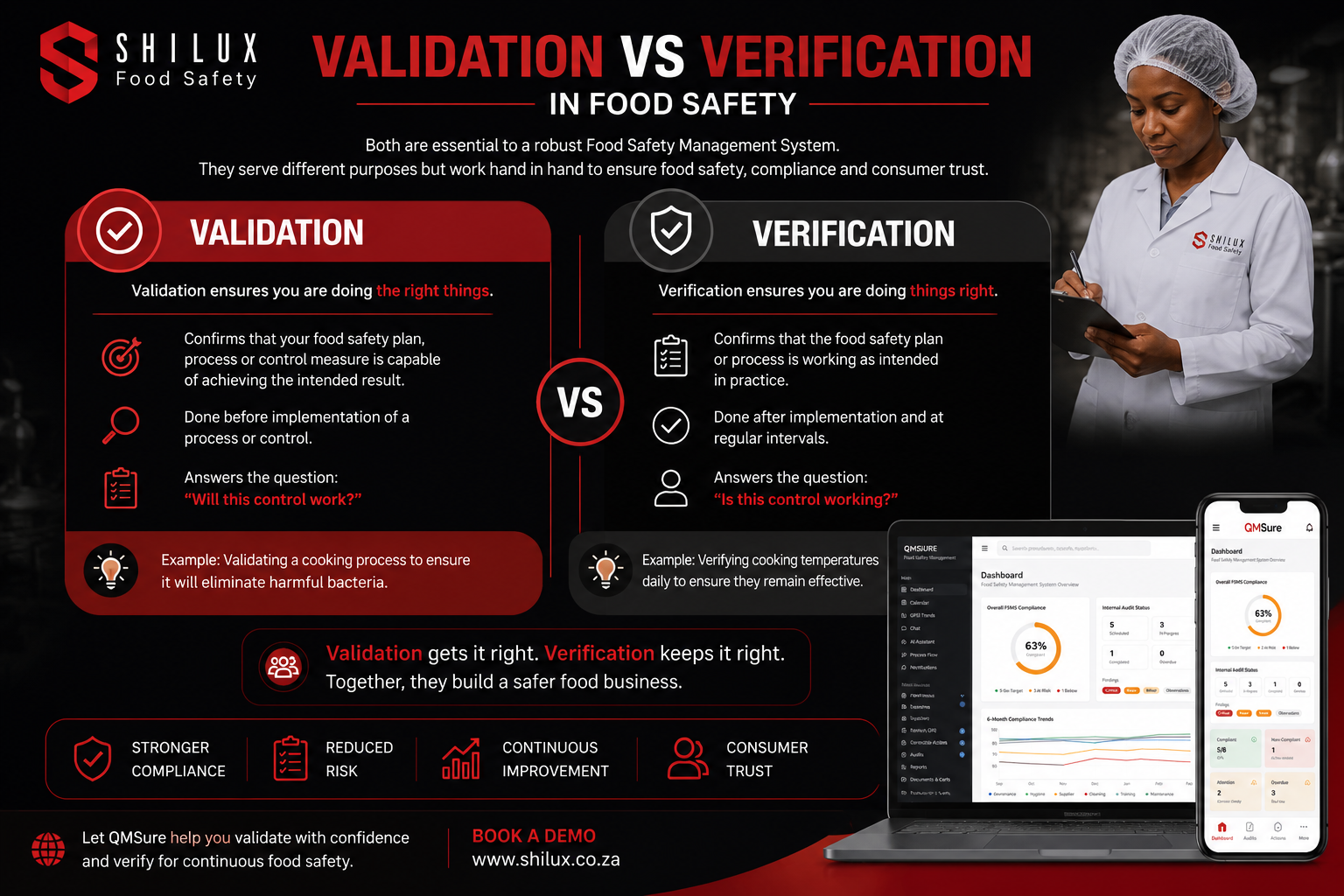
Simply put, validation asks, "Are we doing the right things?" while verification asks, "Are we doing things right?" Understanding the nuances of validation vs verification food safety is the difference between a theoretical plan and a system that actually works in the high-pressure environment of a processing plant.
What is Validation? (Doing the Right Things)
Validation is the process of obtaining evidence that a control measure, or a combination of control measures, is capable of controlling a significant hazard to a specified outcome. In South Africa, if you are setting a critical limit for a pasteuriser, you must prove—through scientific data, laboratory challenge studies, or industry best practices—that those specific temperature and time parameters will kill the target pathogen (e.g., Listeria monocytogenes).
Validation happens before you implement a new process or when change occurs. It is the technical foundation of your HACCP plan.
What is Verification? (Doing Things Right)
Verification involves the application of methods, procedures, tests, and other evaluations, in addition to monitoring, to determine whether a control measure is or has been operating as intended. It is the checking of the work. If your operator records the temperature of a cold room every hour (monitoring), your supervisor checking that log sheet at the end of the shift is verification.
"Validation is the proof that the plan is capable of working; verification is the proof that the plan is actually being followed."
Comparing Validation, Verification, and Monitoring
To ensure a robust Food Safety Management System (FSMS), one must distinguish these from "monitoring," which is the real-time observation of a process.
| Feature | Validation | Verification |
|---|---|---|
| Timing | Prior to implementation (or after changes). | Ongoing throughout production. |
| Primary Goal | Prove the science works. | Confirm procedures are being followed. |
| Example | Using a lab study to prove a 5-log reduction. | Reviewing CCP records or doing micro swabs. |
| Standard Reference | ISO 22000 / SANS 10330:2020 | FSSC 22000 / BRCGS Issue 9 |
Practical South African Examples
Consider a butchery complying with R.638. They decide to use a specific sanitiser on their multi-head scales.
- Validation: The manager reviews the manufacturer’s technical data sheet and SABS certification to ensure the chemical is effective against Salmonella at the recommended dilution.
- Verification: The QA lead performs a weekly ATP swab or environmental microbiological test on the scales to ensure the cleaning team is applying the chemical correctly.
- Monitoring: The cleaning supervisor watches the staff mix the sanitiser to ensures it matches the required parts-per-million (ppm).
Common Pitfalls in Validation and Verification
Many South African food businesses struggle with Root Cause Analysis when a verification check fails. If your micro-results are consistently out of spec, you may have a verification failure (staff aren't cleaning) or a validation failure (the chemical you chose isn't strong enough for the Biofilm present). Using a Root Cause Analysis Masterclass can help identify which side of the fence the problem lies on.
How to Strengthen Your System
Internal auditing is the ultimate verification tool. By enrolling in an Introduction to Internal Auditing, your team can learn how to objectively verify that the site is adhering to its validated HACCP plan. For those in leadership roles, our Validation, Monitoring and Verification course provides the deep dive necessary to satisfy GFSI-benchmarked audits like BRCGS and FSSC 22000.
Is your HACCP plan theoretically sound but failing in practice? It might be time to revisit your validation data or tighten your verification frequencies. Don't wait for a provincial health inspector or a third-party auditor to find the gaps in your system. Book a consultation with Shilux today to ensure your food safety management system is both scientifically valid and consistently verified.