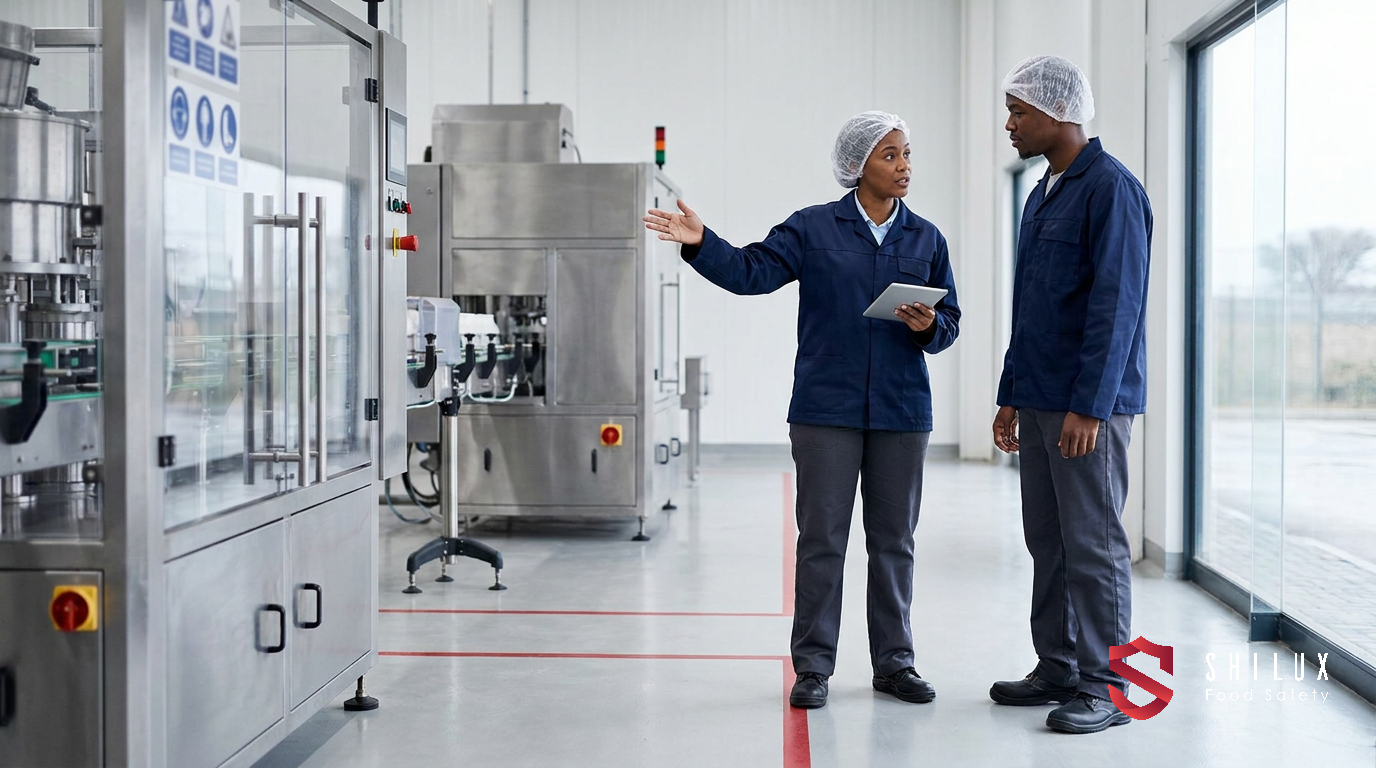
Induction training is critical for new employees because it serves as the primary defense against food safety hazards and ensures immediate compliance with South African regulatory requirements, specifically R.638. By establishing correct hygiene behaviours and Good Manufacturing Practices (GMP) before a staff member enters the production floor, manufacturers significantly reduce the risk of product contamination, recalls, and audit failures.
Key Takeaways
- Legal Mandate: Compliance with Regulation R.638 is impossible without documented evidence of food hygiene training for every person handling food.
- Risk Mitigation: Induction prevents the introduction of physical, chemical, and microbiological hazards by untrained staff.
- Audit Readiness: GFSI-benchmarked standards like FSSC 22000 and BRCGS require comprehensive induction as a foundational Prerequisite Programme (PRP).
- Cultural Foundation: It sets the tone for a site’s food safety culture from day one, emphasizing that safety is non-negotiable.
The Legal Framework in South Africa: R.638 and Beyond
For South African food manufacturers, induction training is a non-negotiable legal requirement. Under the Foodstuffs, Cosmetics and Disinfectants Act 54 of 1972, specifically Regulation R.638 (Regulations Governing General Hygiene Requirements for Food Premises, the Transport of Food and Related Matters), the Person in Charge must ensure that food handlers are adequately trained. An inspector or Environmental Health Practitioner (EHP) will look for training records as a primary condition for maintaining your Certificate of Acceptability (CoA).
Legally, the training must cover the principles of food hygiene and the specific hazards associated with the tasks the employee will perform. If a new employee is found on the line without having undergone a formal induction that covers handwashing, protective clothing, and illness reporting, the facility is in direct breach of national health bylaws. This legal requirement applies to everyone: full-time staff, casual labourers, and even contractors who may enter food-handling areas.
Specific R.638 Training Requirements
Regulation R.638 Section 10 explicitly states that food handlers must be trained in food hygiene by the Person in Charge. This is not a suggestion but a prerequisite for the food premises requirements. Failure to provide this evidence during a municipal inspection can result in a non-compliance notice or, in severe cases, the suspension of the CoA, which legally prevents the business from operating.
Impact on GFSI-Benchmarked Standards
Beyond the law, if your facility is pursuing or maintaining certification such as FSSC 22000 or BRCGS, induction training is scrutinized during every audit. These standards view induction as a critical element of Prerequisite Programmes (PRPs). An auditor will not only check the attendance register but will often interview new hires on the floor to verify if the induction was effective. If an employee cannot explain why they shouldn't wear jewellery or how to report a cooling unit failure, it indicates a failure in the training system.
During GMP audits, auditors frequently look for the "gap" between the induction date and the start date. If an employee started work on Monday but only received induction on Wednesday, any product handled during those two days is technically at risk, leading to potential audit findings and nonconformities. The induction must occur before work commences.
Closing the Competency Gap
Many SMEs make the mistake of assuming that "experienced" hires from other factories don't need a full induction. However, every site has unique HACCP plans, specific Critical Control Points (CCPs), and different chemical handling protocols. Induction ensures that previous bad habits are replaced by your site-specific requirements. For example, a worker from a poultry plant might be used to footbaths, but if your facility uses dry-sanitation for powder blending, they must be re-trained to avoid introducing moisture hazards.
Practical Elements of an Effective Food Safety Induction
A robust induction shouldn't be a generic "tick-box" exercise. It must be tailored to the operational realities of your facility. A meat processing plant in Gauteng will have different induction priorities (e.g., Listeria monocytogenes control) compared to a dry-blending spice facility (e.g., allergen cross-contact).
Essential Induction Modules
| Module | Operational Focus | Regulatory/Standard Driver |
|---|---|---|
| Personal Hygiene | Handwashing technique, no-jewellery policy, hairnet usage, and blue-plaster management. | R.638 & GMP |
| Health Status Reporting | Procedures for reporting diarrhoea, vomiting, or skin infections before entering production. | R.638 Section 11 |
| Cross-Contamination | Physical (wood, glass, brittle plastic) and microbiological (raw vs. cooked separation). | Codex HACCP |
| Allergen Management | Identification of site-specific allergens and cleaning protocols for shared equipment. | R.146 (Labelling) & GFSI |
| Food Defence Awareness | Reporting suspicious behaviour and following visitor management protocols. | TACCP / Food Defence |
| Chemical Safety | Correct dilution of sanitisers and avoiding chemical taints in finished products. | SANS 10049 |
| Traceability Basics | The importance of accurate batch coding and record-keeping on the line. | Batch Traceability |
Operational Deep-Dive: Why These Modules Matter
Personal Hygiene and the Plaster Protocol
In South African manufacturing, physical contamination remains a high-frequency cause of consumer complaints. Induction must go beyond saying "wear a plaster." It must explain the use of metal-detectable blue plasters. A practical demonstration during induction—showing how the metal detector rejects a test piece containing a plaster—builds immediate buy-in. It transitions the rule from "because management said so" to "this is how we protect the consumer and the company."
The "Why" Behind Health Reporting
New employees often fear losing a day's pay if they report being ill. A critical part of induction is explaining the public health risks of Staphylococcus aureus or Salmonella. By referencing local outbreaks, such as the 2017-2018 Listeriosis crisis, trainers can illustrate the catastrophic impact of pathogen transmission. The induction must clarify the company's policy on medical leave for food handlers to ensure honesty in health declarations.
Allergen Control and Cross-Contact
For factories handling South Africa's common allergens (soya, milk, eggs, gluten, nuts, fish), induction is the first line of defense. Staff must be taught that even a microscopic residue can be fatal to an allergic consumer. This includes practical rules like not bringing peanuts into the canteen if the site is "nut-free" or understanding the specific colour-coded cleaning tools used to prevent cross-contact. This aligns with HACCP hazard analysis which identifies allergens as a significant chemical hazard.
The Role of Induction in Food Safety Culture
Induction is the first opportunity a manufacturer has to demonstrate their commitment to food safety. If the induction is rushed, disorganized, or skipped because "production is behind schedule," the new employee receives a clear message: production volume is more important than product safety. This is how food safety culture problems begin.
To build a proactive culture, senior management should ideally participate in or open the induction session. This reinforces leadership in food safety, showing that the highest levels of the company value the protocols being taught. When employees see that the General Manager takes hygiene seriously, they are far more likely to follow the rules when no one is watching.
Failure Modes: Where Inductions Often Fail
- Language Barriers: In South Africa's diverse workforce, conducting induction only in English when staff are more comfortable in isiZulu, Sesotho, or Afrikaans leads to misunderstood instructions. Multi-lingual visual aids are essential.
- Information Overload: Cramming 8 hours of technical HACCP theory into a single session results in poor retention. Use short, high-impact modules.
- Lack of Practicality: Classroom-only training fails to translate to the floor. Induction must include a walkthrough of the actual production environment.
Documentation and Verification: The Auditor’s Perspective
In the world of food safety auditing, "if it isn't documented, it didn't happen." A simple signature on a piece of paper is often insufficient to prove competency. Best practice for induction documentation includes:
- A signed training syllabus: Detailing exactly what topics were covered, including versions of the SOPs discussed.
- Assessment results: A short quiz or practical demonstration (e.g., a handwashing test under UV light) to prove the employee understood the material.
- Verification on the floor: A supervisor signing off after 24-48 hours that the employee is actually applying the GMPs in a real-world setting. This is a key requirement for FSSC 22000 documentation.
- Competency Records: Moving beyond attendance to demonstrate that the individual is capable of performing their specific food safety tasks, such as monitoring a CCP.
For manufacturers struggling with paper-heavy systems, moving to a digital approach like QMSURE can streamline this by linking training records directly to employee files, triggering alerts when refreshers are due and ensuring internal audits are always backed by data.
Integrating Food Defence and Fraud into Induction
Modern standards like FSSC 22000 V6 and BRCGS Issue 9 now require that all staff, including new hires, have an awareness of food defence and food fraud. Induction is the perfect time to explain why certain doors must remain locked and why employees must report any attempt to subvert quality checks. This baseline awareness is the first line of defence against economically motivated adulteration and intentional sabotage.
Staff should be taught to recognize "out of place" individuals or unusual requests for information about production volumes or supplier details. By empowering a new hire to speak up, you strengthen your TACCP risk assessment and VACCP risk assessment outcomes immediately.
Checklist: New Employee Food Safety Induction
Use this checklist to ensure your induction covers the critical bases required by South African EHPs and GFSI auditors:
- [ ] Verification of Health Status: Did the employee sign a medical fitness declaration as per R.638?
- [ ] Personal Protective Equipment (PPE): Has the employee been issued the correct gear and coached on how to wear it (e.g., hair tucked fully into hairnets)?
- [ ] Site Zoning: Does the employee understand high-care vs. low-care areas and the movement restrictions between them?
- [ ] Chemical Handling: If applicable, has the employee been trained on the safe use and storage of cleaning chemicals?
- [ ] Waste Management: Does the employee know which bins are for food waste and which are for packaging?
- [ ] Emergency Procedures: Does the employee know how to stop the line if a safety or food safety risk is identified?
- [ ] Glass and Brittle Plastic: Awareness of the site's policy on bringing glass onto the floor (e.g., lunch containers or perfume bottles).
- [ ] Reporting Non-Conformities: Do they know who the Quality Controller is and how to report a spill or a broken equipment part?
Audit Preparation and Common Pitfalls
During a readiness audit, one of the most common findings is "Training records incomplete for temporary staff." Many facilities use labour brokers for seasonal peaks, especially in the fresh produce and agriculture or bakery and confectionery sectors. It is a critical error to assume the broker has trained the staff. The manufacturing site is legally responsible for the hygiene of anyone on their premises.
Another common failure is the lack of a "Refresher Training" schedule. Induction is not a one-time event; it is the start of a continuous learning journey. Standards like BRCGS require that if a significant change occurs—such as a new allergen being introduced to the site or a food recall incident—all relevant staff must undergo a focused retraining session to prevent recurrence. Using root cause analysis after a site failure often points back to a lapse in the original induction or a lack of subsequent refresher training.
Conclusion
Induction training is the foundation upon which a safe food manufacturing operation is built. By investing the time to properly onboard new staff, South African manufacturers protect themselves from the significant legal and financial consequences of foodborne illness outbreaks and product recalls. It is not just a regulatory hurdle; it is a strategic investment in your brand's integrity and your workforce's competence. A well-inducted employee is an empowered guardian of your product's safety.
Shilux provides comprehensive support for manufacturers looking to strengthen their training programmes. Whether you need expert consulting on training strategy, specialized HACCP implementation workshops, or a digital solution to manage your training records via the QMSURE system, our team is ready to assist you in achieving sustainable compliance. We also offer targeted supplier audits to ensure your raw material providers are maintaining the same high standards of induction and training within their own facilities.