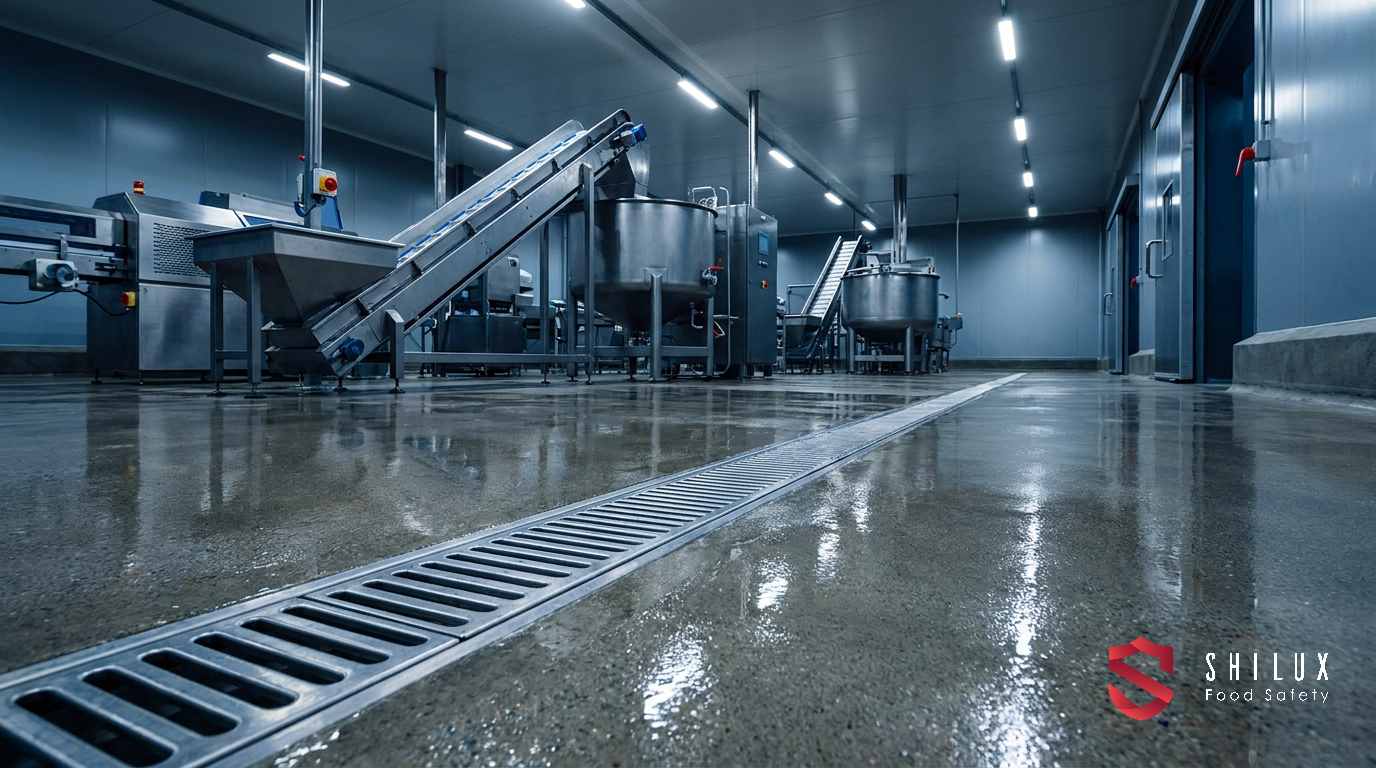
Effective waste management and drainage control in food processing facilities serve as fundamental barriers against microbial cross-contamination, pest harborage, and environmental hazards. In South Africa, these controls are a legal requirement under the Foodstuffs, Cosmetics and Disinfectants Act 54 of 1972 and its primary hygiene regulation, R.638. Failure to maintain adequate systems not only risks the suspension of your Certificate of Acceptability but also leads to major non-conformities in GFSI-benchmarked audits like FSSC 22000 or BRCGS.
Key Takeaways
- Legal Compliance: Adherence to R.638 is mandatory for all South African food handlers, specifically regarding the prevention of nuisance and contamination.
- Hygienic Design: Drainage must flow from high-risk (clean) areas to low-risk (dirty) areas to prevent aerosolized contamination.
- Pest Management: Waste areas are primary attractants; external storage must be secured, sloped, and regularly sanitized.
- Operational Controls: Documentation of waste disposal by licensed contractors is vital for both environmental law and traceability.
- Listeria Prevention: Drains are notorious reservoirs for Listeria monocytogenes; they require specific mechanical cleaning and sanitization protocols.
The Regulatory Landscape in South Africa
Before considering international standards, South African food manufacturers must comply with the Regulations Governing General Hygiene Requirements for Food Premises, the Transport of Food and Related Matters (R.638). Clause 5 of R.638 explicitly mandates that food premises must have an effective waste disposal system. This includes the provision of refuse containers that are leak-proof, easy to clean, and fitted with tight-fitting lids.
Beyond hygiene, the National Environmental Management: Waste Act 59 of 2008 dictates how industrial waste, including organic food waste, is handled, stored, and transported. For QA managers, this means that a Certificate of Acceptability is contingent on demonstrating that waste does not accumulate in food handling areas and is disposed of in a way that does not pollute the environment or attract pests. Common failure modes include the lack of a designated, vermin-proof waste room or the failure to separate hazardous chemical waste from organic food waste, both of which are common triggers for a failure in food premises inspections.
Drainage Control: The Hidden Risk
In most meat and poultry or dairy facilities, the drainage system is a primary vector for pathogens. If drains are poorly designed or maintained, they become breeding grounds for biofilms. Under HACCP for food manufacturers in South Africa, drainage is classified as a critical Prerequisite Programme (PRP).
Hygienic Drainage Design Principles
To meet FSSC 22000 requirements and SANS 10049 standards, drainage systems should incorporate the following:
- Flow Direction: Drains must never flow from a low-risk area (e.g., raw receiving) into a high-risk area (e.g., ready-to-eat packaging). This prevents the backflow of contaminated water and odours. This is particularly critical in South African abattoirs where the "dirty" side (slaughter) must remain hydraulically isolated from the "clean" side (chilling and deboning).
- Accessibility: Drains must be accessible for cleaning and inspection. Avoid placing heavy machinery directly over floor drains. A common audit finding is the inability to remove a drain grate because it has been welded shut or blocked by permanent equipment.
- Traps and Grates: All drains must be fitted with removable grates and P-traps to prevent pest entry and the escape of sewer gases. In South Africa, cockroaches are a frequent pest in poorly maintained P-traps.
- Materials: Stainless steel is the gold standard. Cast iron or porous concrete should be avoided in processing zones as they pit over time, creating microbial niches. If concrete channels are used, they must be lined with food-grade epoxy that is inspected regularly for cracks.
Maintenance and Cleaning of Drains
Drains should be cleaned at the end of every shift, but mechanical scrubbing is essential to break down biofilms. A common audit finding during hygiene audits is the use of high-pressure hoses in drains while food is present. This is a critical error; high pressure creates aerosols that can carry Listeria from the drain onto food-contact surfaces. Drains should be cleaned using dedicated, colour-coded equipment (usually black or red) to prevent cross-contamination with production tools.
Operational Detail: The "Three-Step Drain Process" involves: 1. Removal of solid debris and placing it in a dedicated waste bin (not flushing it down the drain); 2. Application of a foaming alkaline cleaner to penetrate fats; 3. Mechanical scrubbing with a dedicated brush, followed by a low-pressure rinse and the application of a non-rinse quaternary ammonium sanitizer or chlorine dioxide.
Waste Management: Strategic Handling and Storage
Waste is not merely "rubbish"; in a food safety context, it is any material—organic or inorganic—that is no longer required for the process and poses a risk to the product. Effective waste management is a cornerstone of prerequisite programmes.
Internal Waste Handling
Inside the facility, waste bins should be clearly identified. A best practice is to use colour-coding (e.g., green for recycling, black for general waste, and red for condemned/high-risk waste). Bins must be foot-operated to prevent hand contact and must be emptied regularly—never allowed to overflow. Audit observations often highlight "over-capacity" bins as a sign of poor food-safety culture. If employees feel they cannot leave the line to empty a bin, or if there aren't enough bins provided, they will instinctively pile waste on floors or tables, leading to a major nonconformity.
External Waste Storage Areas
The external waste area is often the most neglected part of a facility. To satisfy an Environmental Health Practitioner during an inspection, the following must be true:
| Feature | Requirement | Reasoning |
|---|---|---|
| Surface | Hard-surfaced (concrete) and sloped | Prevents pooling of contaminated liquids and allows for washing. |
| Drainage | Connected to a grease trap or sewer | Prevents run-off into stormwater systems, which is a violation of municipal bylaws. |
| Security | Fenced and locked | Prevents unauthorized access, animal scavenging, and potential food defence threats. |
| Pest Control | Bait stations positioned nearby | Waste areas are the first line of defence against rodent ingress. |
| Cleaning Schedule | Daily wash-down with disinfectant | Eliminates odors and organic matter that attract flies and birds. |
Handling Condemned and Recalled Product
When a product is rejected due to safety concerns (e.g., physical contamination or pathogen detection), it must be handled under strict waste protocols to prevent it from re-entering the food chain. This is a vital component of a food recall plan. In South Africa, "grey market" diversion of condemned food is a significant risk where intercepted waste is resold in informal settlements. Manufacturers must ensure that condemned products are denatured (e.g., sprayed with a dye like Brilliant Blue) or destroyed by a reputable waste contractor who provides a Certificate of Destruction. Failure to prove the destruction of unsafe food is a common cause of audit findings during traceability exercises.
Waste Documentation and Traceability
For those pursuing BRCGS certification, documentation is paramount. You must be able to prove where your waste goes. This includes:
- Waste Transfer Notes: Records from your waste removal contractor showing the date, volume, and type of waste removed.
- Recycling Records: Data on volumes of plastic, cardboard, or organic waste diverted from landfills, which supports corporate sustainability goals.
- Service Level Agreements (SLAs): Ensuring your waste contractor complies with municipal bylaws and environmental standards. As part of supplier management, you should periodically audit your waste service provider to ensure they aren't illegally dumping your branded packaging.
Advanced Audit Readiness: The Mass Balance
During a traceability exercise, auditors may perform a mass balance. If you received 10,000kg of raw material and produced 8,000kg of finished product, you must account for the 2,000kg of "waste" (shrinkage, bones, trim, floor sweepings). If your waste records only show 500kg removed, the auditor will suspect either poor record-keeping or unauthorized product diversion.
Internal Waste and Drainage Audit Checklist
- Are all internal waste containers clean, lidded, and labelled according to the site's colour-coding policy?
- Is there any evidence of standing water or "pooling" near floor drains, indicating improper floor slope?
- Are drain grates intact, free of debris, and easily removable for cleaning?
- Is the external waste area free from lingering odours and visible pest activity (e.g., fly larvae or rodent droppings)?
- Are cleaning chemicals for drains stored in a locked area away from food production?
- Do employees understand the colour-coding system for waste, and can they explain what happens to condemned product?
- Are P-traps filled with water or sanitizer to maintain the seal against sewer gases?
- Are waste exit doors kept closed when not in use to prevent pest ingress?
Common Failure Modes and Corrective Actions
In many South African facilities, the transition between "wet" and "dry" cleaning leads to drainage failures. In a dry-clean environment (like a bakery), introducing water into drains can actually trigger a Salmonella outbreak. In these cases, drains should be kept dry and vacuumed rather than hosed. If a drain becomes blocked, a common failure is using a plunger or a high-pressure "snake" without stopping production. This releases pressurized contaminants into the air. The CAPA process for a drainage failure must include a full room sanitation after the blockage is cleared.
Another failure mode is the use of porous wooden pallets in waste areas. These absorb organic liquids and become impossible to sanitize. All waste-handling equipment should be non-porous and easily cleanable. If you identify such issues, perform a root cause analysis to determine if it is a procurement failure or a lack of training for the cleaning crew.
Integration with Food Safety Management Systems (FSMS)
Waste and drainage controls should not exist in isolation. They must be integrated into your internal audit schedule. During a GMP audit, the auditor will look for the "flow" of the facility. If the waste exit route crosses the path of incoming raw materials, this is a significant cross-contamination risk that requires a formal root cause analysis and corrective action.
Furthermore, the maintenance of the drainage system should be part of the preventative maintenance schedule. Gaskets, traps, and the integrity of floor seals around drains must be inspected quarterly. A common site for Listeria is the gap between a stainless steel drain and the surrounding floor screed. If this seal fails, water seeps under the floor, creating a hidden reservoir of bacteria. Using a food premises hygiene requirement checklist can help maintenance teams identify these structural risks early.
Practical Tips for South African SMEs
Small and medium enterprises (SMEs) often struggle with infrastructure costs. However, drainage compliance can be improved without a total floor overhaul. Simple actions like replacing damaged plastic drain covers with stainless steel, implementing a strict "no-overflow" policy for bins, and ensuring the external waste area is washed down daily with a SABS-approved disinfectant can significantly reduce risk profiles. If you are unsure of your facility's compliance, a readiness audit can identify gaps before a formal inspection or certification audit occurs.
Consider the "Waste-Walk": Once a week, the Food Safety Team should walk the path of waste from the point of generation to the final disposal gate. This often reveals issues like leaking bags in hallways or waste bins being used as temporary tables for food containers—a critical violation of R.638 regulations.
Waste management and drainage control are the "unglamorous" side of food safety, but they are the foundations upon which safe food production is built. By ensuring these systems are robust, South African manufacturers protect their consumers, their brand reputation, and their legal standing in a highly regulated market. Robust waste controls are not just about neatness; they are a strategic part of food fraud mitigation and food defence, ensuring that rejected product never reaches a consumer's plate.
At Shilux, we assist South African food manufacturers in bridging the gap between basic compliance and global safety excellence. Whether you require a gap audit to identify infrastructure weaknesses or need to digitise your hygiene and waste records using the QMSURE paperless system, our expert consultants and trainers are here to help. Contact us today to strengthen your prerequisite programmes and ensure your facility remains audit-ready and legally compliant.